If your vehicles run salted winter roads, treat chassis and underbody washing as something you specify into the wash system from the start, not a wand or arch you bolt on later. The reason is simple. Road salt attacks the frame itself, frame condition is a federal inspection item that can take a unit off the road, and the civil work, drainage and water treatment that an underbody stage needs are far cheaper to build in than to retrofit. Designing it in protects the vehicle, keeps the fleet compliant, and keeps the wash bay legal on its discharge.
Salt corrodes the frame, not just the finish
Deicing salt does real, expensive damage. The US Environmental Protection Agency reports that rock salt used for winter deicing has corrosive effects in large quantities that affect cars, trucks, bridges and roads, amounting to roughly 5 billion dollars in annual repairs in the United States alone. On a heavy vehicle the vulnerable areas are not cosmetic. They are the places salt-laden brine collects and sits: gusset connections, frame corners, cross members and the undercarriage, well out of sight of a top wash.
FMCSA’s own guidance for cargo tanks makes the point directly, naming areas on the tank and frame that accumulate both salt and road debris, such as gusset connections and frame corners, and stressing regular cleaning. You can read it in the cargo tank guidelines. The washing happens underneath, where a standard rollover or tunnel does not reach, which is exactly why the undercarriage needs its own treatment.
Frame condition is a compliance item, not a cosmetic one
This is where corrosion stops being a maintenance nuisance and becomes a roadside risk. Under 49 CFR 393.201, enforced through FMCSA’s safety programme, the frame or chassis of each commercial motor vehicle must not be cracked, loose, sagging or broken. Frame members are also a named line on FMCSA’s Annual Vehicle Inspection Report. An inspector looks at the frame, and years of accumulated salt sitting in the corners is working against you.
The consequence of a frame defect found at the roadside is blunt. FMCSA guidance on moving an out-of-service vehicle says it may only be loaded onto another vehicle, towed, or driven once the out-of-service condition no longer exists. The detail is in this FMCSA question on section 396.3. A corrosion-driven frame problem can hold a unit until it is repaired. Regular underbody washing is one of the few controllable things that slows the process that leads there. For the wider case on why these vehicles cannot share a car-grade machine, see why heavy vehicles need their own wash system.
Why it has to be designed in, not retrofitted
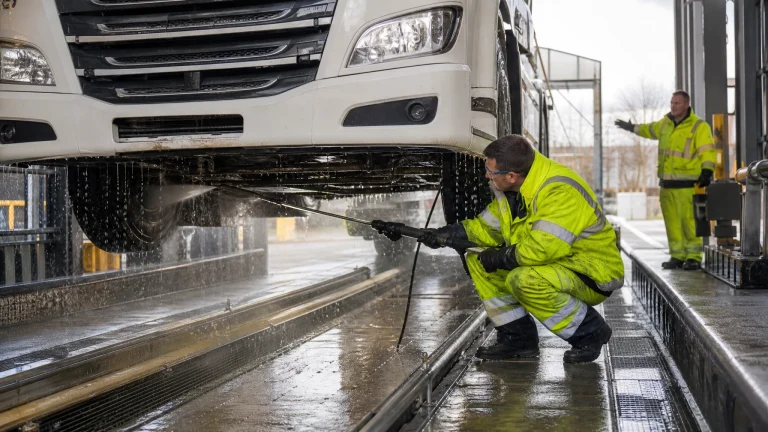
An underbody stage is not a spray bar you add in year three. The arches or manifolds that wash the chassis need clearance, a drainage slope in the slab and plumbing runs for both supply and reclaim. As a practical matter, adding that after a tunnel is poured usually means re-trenching floors and re-routing water lines, which is slow and costly. Building the undercarriage stage into the original civil and mechanical design is the cheaper path, and it is the one that works. This is also why underbody capability belongs in the conversation when you are sizing a truck wash for the fleet you actually run, and it is treated at length in our piece on chassis and underbody washing as a system decision.
There are sensible design patterns here, offered as practitioner guidance rather than a rule. Many operators separate an undercarriage pre-treatment, a rinse or soak to dissolve salt, from the final high-pressure rinse, so that direct high-pressure water stays off wiring harnesses, air lines and electrical connectors. A drive-through layout, rather than drive-over-and-stop, keeps a full tractor-trailer combination moving and protects throughput. In freeze climates, heated wash water and freeze-protected plumbing are commonly specified so that salty brine does not simply refreeze on components after the wash. The cold-weather side of this is covered in keeping a depot wash working through winter.
The wash water is a compliance problem of its own
Underbody wash water is not the same as top-wash water. It carries dissolved road salt, oil, grease and undercarriage grime. EPA’s stormwater best-practice guidance notes that vehicle and equipment washing can generate discharges contaminated with sediment, detergents, oils, grease and heavy metals. That means the undercarriage stage needs its treatment train designed at build time, not patched in once a regulator asks questions.
Water reclaim is part of this. EPA’s WaterSense at Work guidance says a reclamation system should at minimum separate grit, oil and grease, and that this base level of treatment is enough to use reclaimed water during the rocker and undercarriage wash stage. The water saving is worth having, and designing it in beats bolting it on. As a directional benchmark only, and from general vehicle-wash industry data rather than heavy-truck-specific figures, EPA reports that conveyor washing without reclamation can use 65.8 gallons of fresh water per vehicle during friction washing, falling to as low as 7.8 gallons per vehicle with reclamation. Read those as indicative of the scale of the saving, not as a number to quote for a specific truck.
A wet under-vehicle bay is a safety question too
A purpose-built chassis bay is safer than a jury-rigged wand station. OSHA maintains a formal alliance with the International Carwash Association aimed at reducing workplace hazards in the industry. Where undercarriage degreasers or acid-based brighteners are used, OSHA has clarified that there is no threshold quantity of corrosive material that triggers the requirement for accessible quick-drenching or flushing facilities within the work area. Design the bay so the chemistry, the drainage and the drenching provision are all accounted for, rather than discovering the gap after someone is working under a wet vehicle.
Where Europe Makine fits
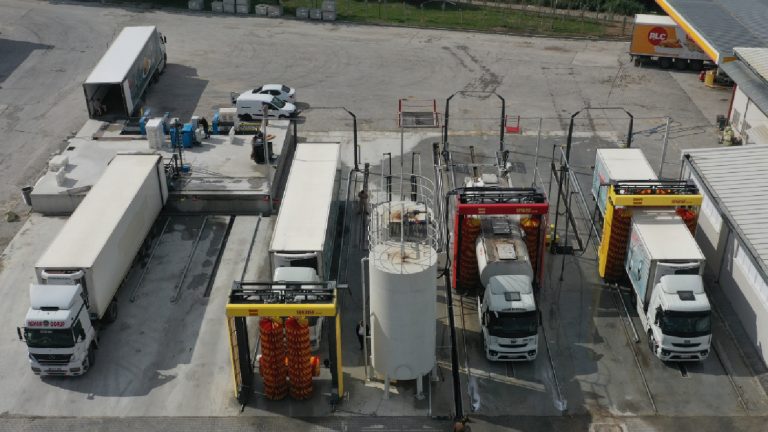
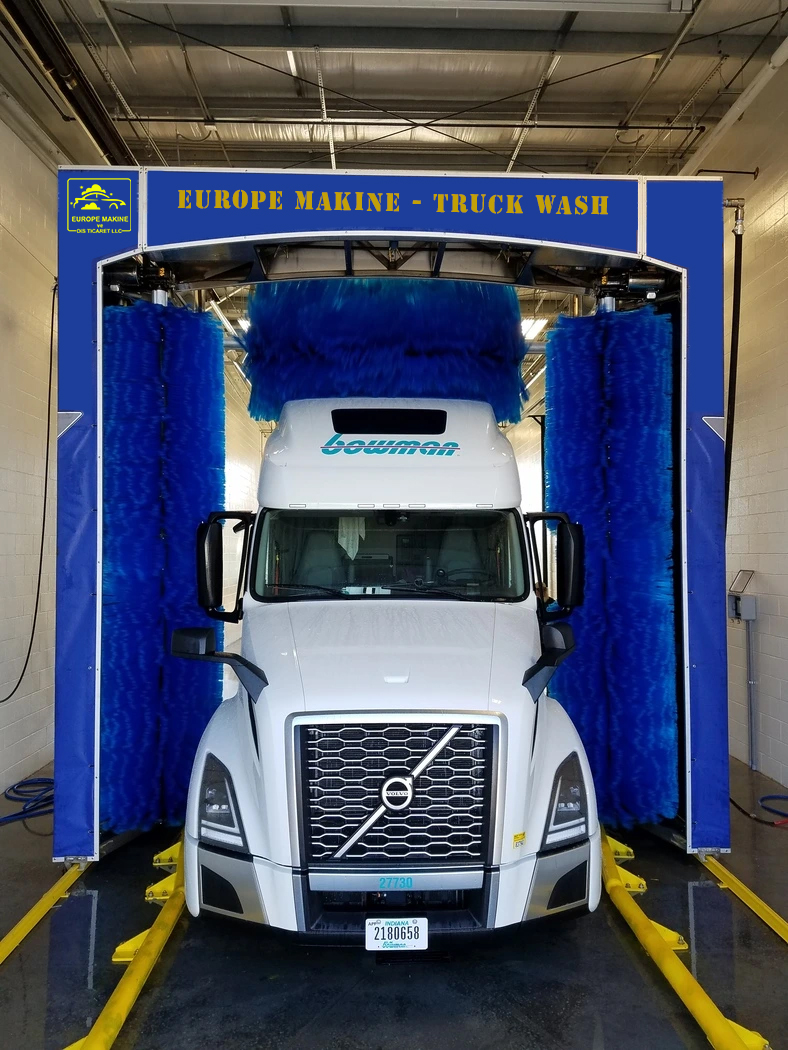
Europe Makine builds the SUNRISE heavy vehicle wash and develops complete turnkey heavy-vehicle sites, which means the undercarriage stage, the slab drainage and the water handling can be specified together from the first drawings rather than reconciled later. That is the quiet advantage of treating chassis washing as a system decision: the machine, the civil work and the discharge plan are one design, handed over working.