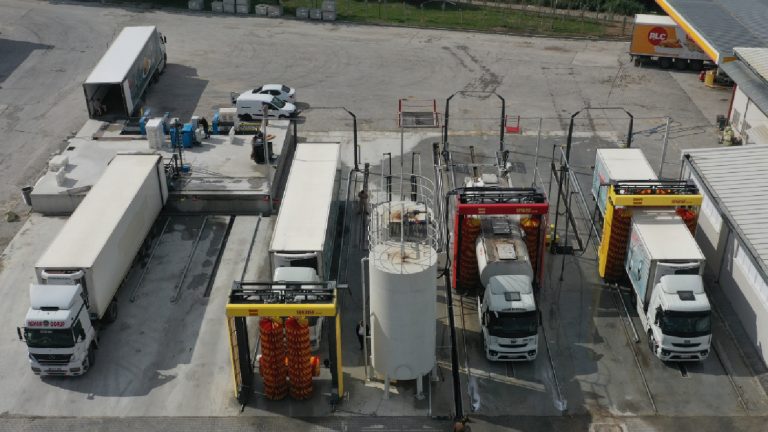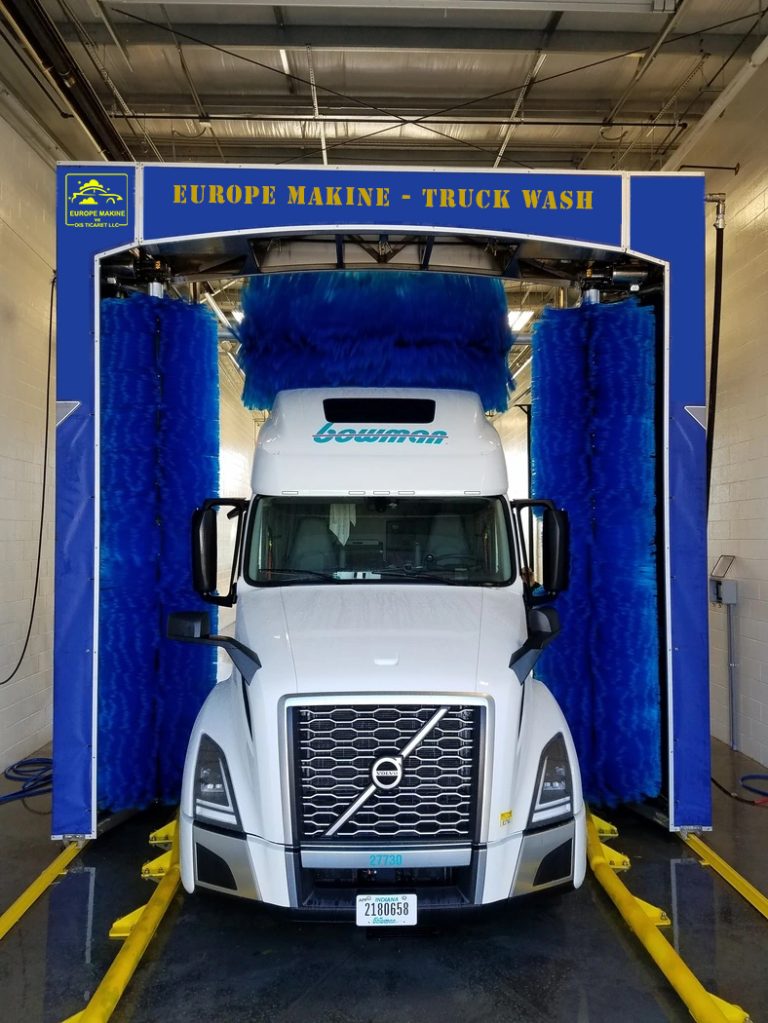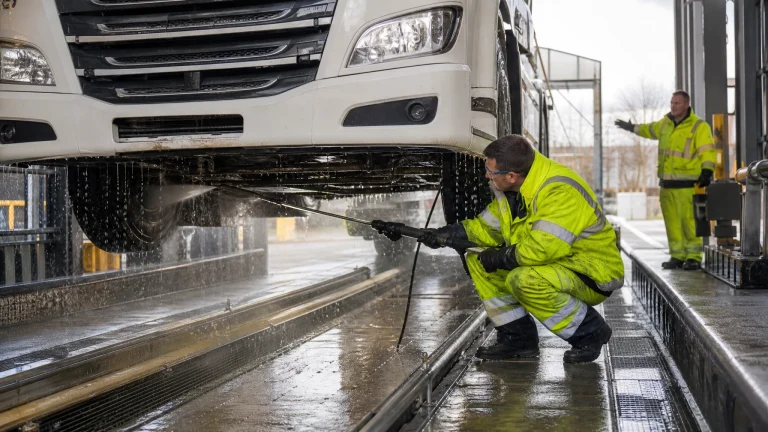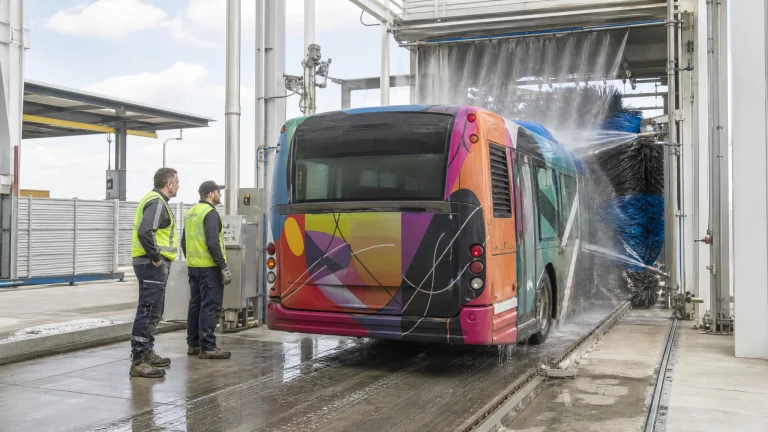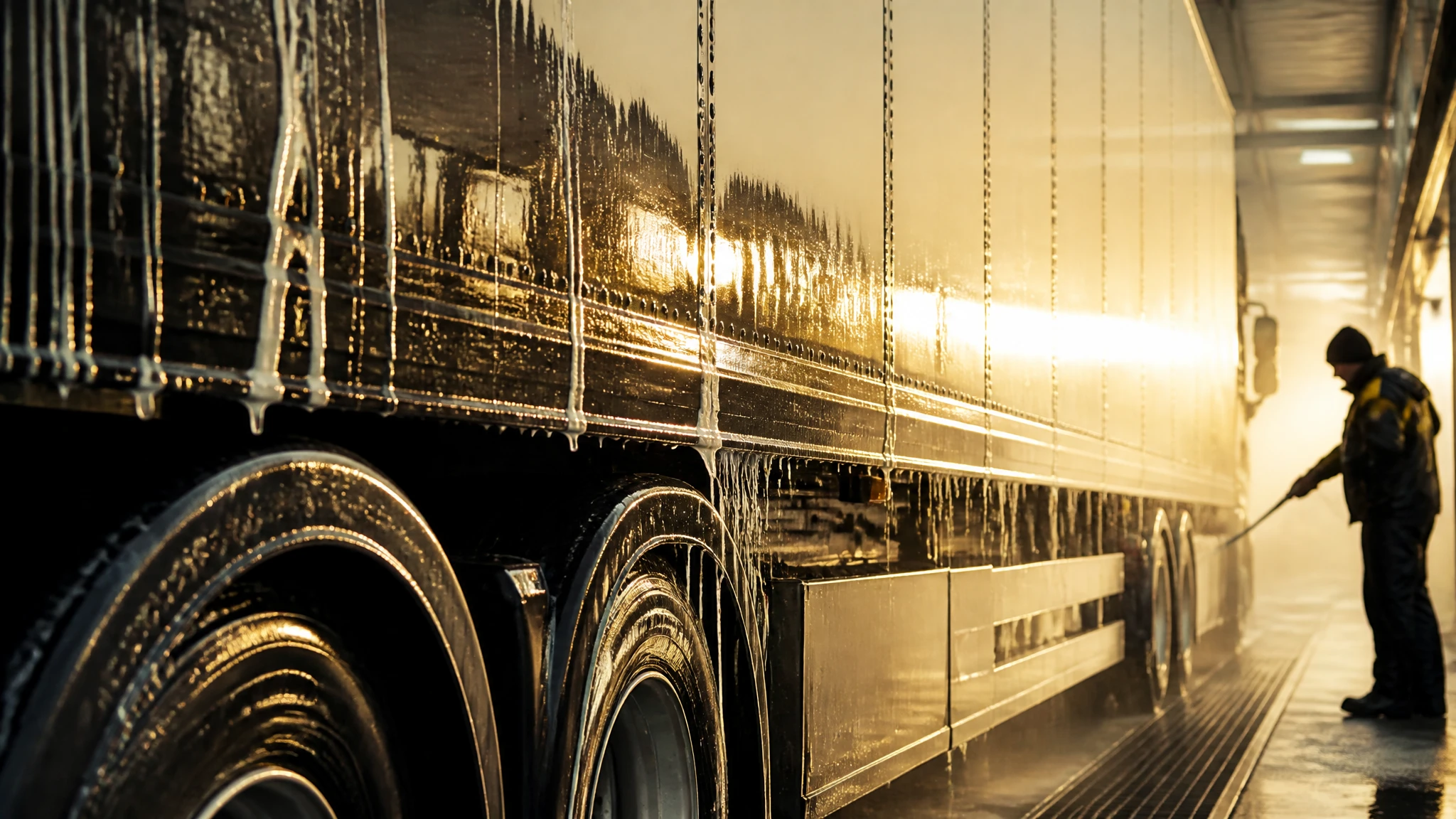
An automatic bay can handle a trailer wash for box vans, reefers, flatbeds and tankers, but only if the bay, the machine and the wastewater arrangements were designed for vehicles of that size. It washes the outside. It does not clean the inside of a tank, which is a separate and regulated job. Whether your particular trailer fits is a question for the bay’s written specification, not for a general rule.
What an automatic bay does to a trailer
EPA describes the in-bay automatic type as one where the vehicle stays stationary while sprays or brushes on a moving gantry do the washing. It can be friction or frictionless. That is the basic format whether you are washing a pickup or a truck and trailer wash set-up built for heavier vehicles.
The same EPA section notes that most in-bay automatic equipment can use sensors to detect vehicle length, which saves water on shorter vehicles. For trailers this matters in a practical way: a 28-foot pup and a full-length semi trailer should not get the same cycle.
The EPA text we have is written around passenger-vehicle studies and gives no trailer-specific figures. So any claim about trailer dimensions, cycle time or capacity needs to come from the equipment supplier for the specific machine.
Match the wash to the trailer type
The four trailer types in this article share one thing: you want the outside clean. They differ in shape and in what the wash has to avoid or reach. A tractor trailer wash is rarely one-size-fits-all.
Box vans and reefers
Dry vans and refrigerated trailers present large, flat sides and a flat rear door. The wash has plenty of surface to cover, so coverage along the full length is the main question. Ask how the equipment handles the full length and height of the trailer, and whether the cycle can be set for a long vehicle.
Reefers add a refrigeration unit and its housing at the front. How a given machine treats that area is something to confirm with the supplier before you drive in. We have no verified evidence on this, so treat it as a question to ask rather than an assumption.
Flatbeds
A flatbed has an open deck and no sealed cargo area. There is nothing to protect inside, but there are often loose items such as straps, chains, dunnage and tarps. Those can snag or be thrown about by brushes and high-pressure arms. Clearing the deck before the wash is sensible, and you should ask whether a friction or frictionless system suits your loads. Our article on touchless or brushes sets out what each approach trades.
Tankers
Tank trailers can have an exterior wash like any other trailer. The inside of the tank is a different activity entirely, and it should not be part of what you expect from a bay.
Exterior wash is not tank-interior cleaning
EPA’s Transportation Equipment Cleaning rule, 40 CFR Part 442, covers the interior cleaning of tank trucks, rail tank cars, intermodal tank containers, tank barges and closed-top hopper barges. EPA says it was promulgated in 2000, and estimates that about 2,400 facilities perform these cleanings.
The rule excludes facilities that do not clean tank interiors. It also excludes those that clean tank interiors only for repair and maintenance, which EPA says may fall under a different set of guidelines (40 CFR Part 438). In plain terms, an exterior wash bay and a tank-interior cleaning operation are different things in the eyes of the regulator.
There is a safety side as well. In a Region VI directive, OSHA states that transportation tanks are confined spaces that may contain a hazardous atmosphere risking death, incapacitation or acute illness. Depending on cargo, tank configuration and cleaning method, a tank may have the characteristics of a permit-required confined space. That directive is a regional emphasis programme, not a nationwide rule, and we cite it only to explain why tank interiors sit outside an automatic exterior bay.
None of this is a legal conclusion about your site. Confirm what applies to you with your local wastewater authority and permit writer.
Where the water goes
For a fleet, the strongest argument for washing in a bay rather than in the yard is the water. EPA’s stormwater fact sheet says that outdoor washing can send detergent-rich water to storm drains, and that this water may carry nutrients, metals and hydrocarbons. The same fact sheet says most stormwater impacts from washing come from residents, fleet management activities and charity fundraisers, while commercial car washes reduce the impact because they often recycle water or must treat wash water before release to the sanitary sewer.
Reclaim is the other half. EPA’s vehicle wash section says water reclamation systems can be retrofitted to conveyor and in-bay automatic washes. It cites studies in which average fresh water use in in-bay automatics was 43.3 gallons per vehicle in a 2002 study and 44.8 gallons in a 2018 study. Without reclaim it can reach 74.1 gallons, and with reclaim it can be as low as 19.1 gallons.
Those figures come from the studies EPA cites, which are oriented to passenger vehicles. They are not trailer-wash figures and you should not expect the same numbers for a 53-foot trailer. They show only that reclaim makes a real difference to fresh water use.
What you can do with wash water is set locally. Discharge limits, pre-treatment and permits are usually decided by the sewer authority or permitting body, so this conversation should happen before the bay is designed, not after. Our piece on the utilities survey covers the water and power side of that early work.
A word on lights and reflectors
A wash that removes road film also exposes lamps and reflectors. FMCSA’s safety planner explains that lighting devices and reflectors are required on commercial vehicles, and that certain trailers built on or after December 1, 1993, must have retroreflective sheeting or extra reflex reflectors. The page does not set a cleaning requirement, so we do not claim one. It is simply a reminder that these parts matter, and a wash is a good moment to look at them.
Questions to ask before bringing a trailer
- What is the maximum vehicle length, width and height the bay and machine are specified for, in writing?
- Does the machine adjust its cycle to the length of the trailer?
- Is the wash friction, frictionless or a combination, and which suits your loads and fittings?
- Does the bay recycle wash water, and is there pre-treatment before the sanitary sewer?
- What has the wastewater authority said about discharge from this site?
- Are tank interiors excluded from the service, and is that clear to drivers?
If you run a fleet, what a fleet should specify in a wash arrangement goes through these points from the buyer’s side. For the wider reasons heavy vehicles need different equipment, see why heavy vehicles need their own wash system, and for the format choice, rollover or tunnel.
Where Europe Makine fits
Europe Makine manufactures five wash systems, including the SUNRISE W4000/W4700 heavy vehicle wash, alongside touchless, three-brush and five-brush rollovers and a conveyor tunnel. We do not state which trailer types any model handles here; that has to be confirmed against the specification for the machine and your site. Where a build is turnkey, the work covers securing the site, clearing permits, installing and calibrating the machines, and training the crew. What a turnkey car wash actually includes explains that process in more detail.