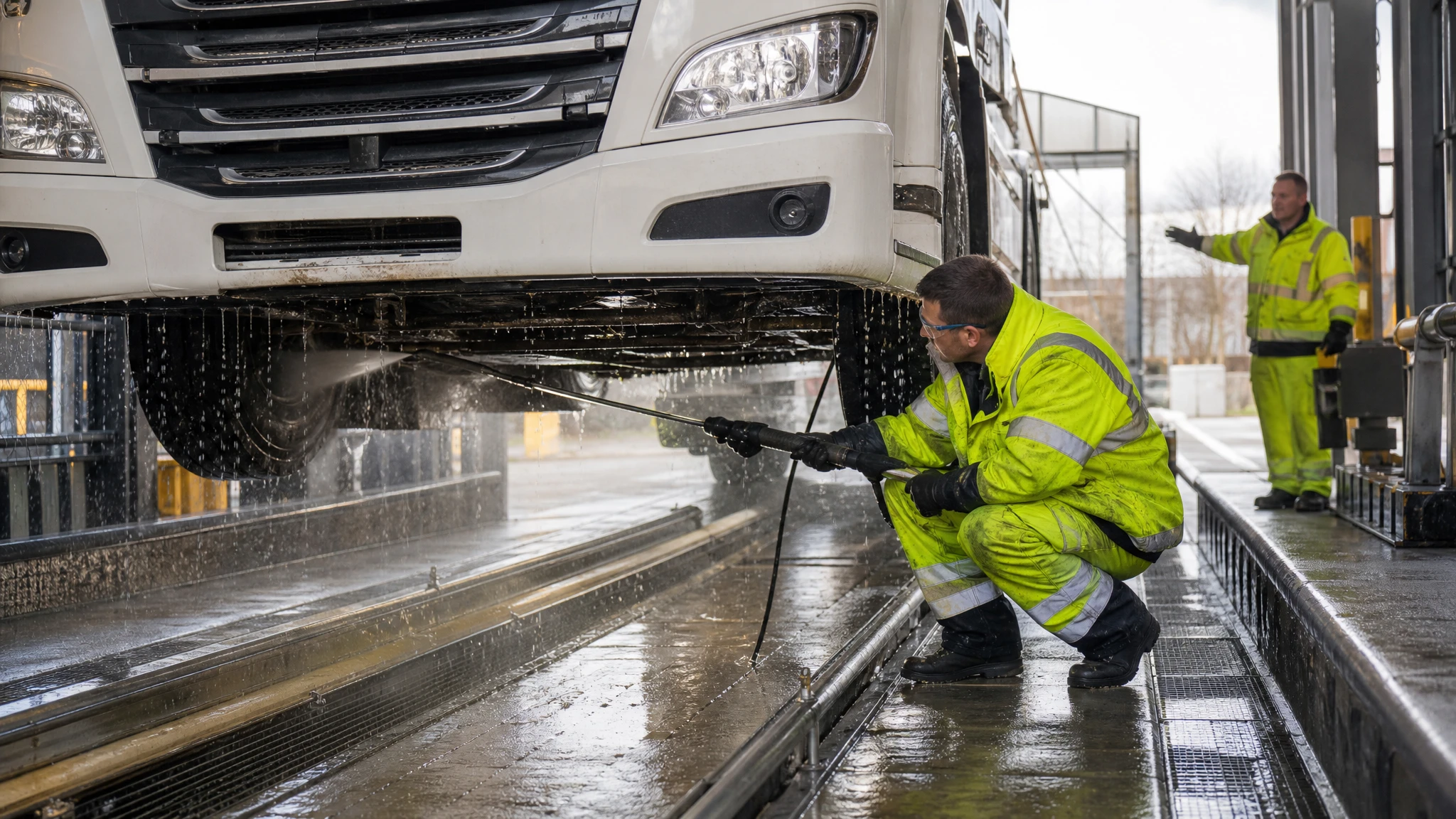
If your trucks or buses spend the winter on salted roads, underbody and chassis washing is worth specifying, and the sensible way to think about it is as part of the wash system rather than a nozzle bar added at the end. The value is not a cleaner-looking chassis. It is a frame that stays inspectable, a corrosion clock that runs slower, and a discharge arrangement that holds up when someone from the authority having jurisdiction asks how the water leaves your site. Those are engineering outcomes, and they are decided when the system is designed.
The corrosion case is bigger than surface rust
Road salt does real, measurable damage. The EPA notes that rock salt in large quantities has corrosive effects on cars, trucks, bridges and roads, contributing to around $5 billion in annual repairs in the United States, and that a single state, Massachusetts, uses close to half a million tons of rock salt each winter (EPA, Winter is Coming). The alternatives do not remove the problem. Magnesium chloride is gentler than sodium chloride but needs about twice the quantity for the same coverage, and calcium chloride is easier on the environment but roughly three times the cost, so it tends to be reserved for vulnerable areas (EPA).
Agencies are working to use less. Nevada’s anti-icing programme cut road salt use in half and sand use by around 70 percent (FHWA), and Iowa reported saving more than $2.7 million a year on salt after adopting a management tool in 2012 (FHWA ITS evaluation). None of that changes the fleet manager’s position. You cannot control how much chloride is on the road. You can only control how quickly it is rinsed off the underside of your vehicles.
A clean chassis is an inspectable chassis
This is where chassis washing stops being cosmetic. Federal roadworthiness rules treat the frame as a safety-critical item. Under 49 CFR 393.201 the frame or chassis must not be cracked, loose, sagging or broken (FMCSA CSA, Frames), and parts and accessories, including frames and frame assemblies, must be in safe and proper operating condition at all times (FMCSA, Part 396). Every commercial vehicle needs a periodic inspection at least once every 12 months, with the report retained for 14 months (FMCSA).
A chassis packed with salt-laden grime is harder to inspect properly and better at hiding the defect that surfaces at a roadside stop. When that happens, the vehicle can be placed out of service, meaning it must be taken off the road until the problem is corrected (FMCSA glossary). That is lost dispatch, not just a maintenance line. Regular underbody washing supports the inspection you are already required to carry out.
Why it is a system decision, not a nozzle kit
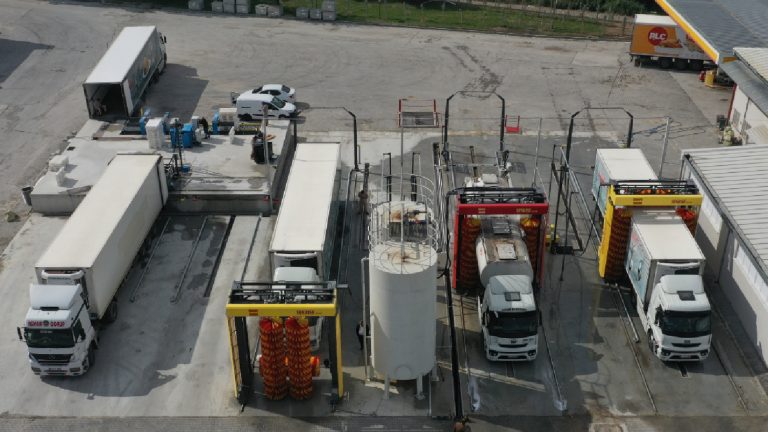
The reason underbody washing belongs in the system design is water. Once you are spraying the dirtiest part of the vehicle with salt, oil and road film, you have to decide how that water is captured, treated and discharged, and those choices are facility-specific.
The EPA describes water reclamation, treating and reusing wash and rinse water, as the strategy with the greatest water-saving potential for vehicle washes, but it only works if the flow rate of each process, the chemistry in use, any discharge limits, and the intended reuse quality are all assessed up front (EPA WaterSense at Work). Reclaim also carries ongoing work to keep filters and components clean, and it can be retrofitted to conveyor or in-bay systems but is not recommended for self-service formats (EPA). That is the whole point: an underbody stage decided late forces these questions after the drainage, separators and tanks are already poured.
Two further constraints sit under this. Grit and sediment pulled out by an oil and water separator is a regulated waste stream under the Resource Conservation and Recovery Act, though most such sludge is non-hazardous under the toxicity characteristic rule (ICA water effluent report). And if you run tank or bulk equipment, the Transportation Equipment Cleaning effluent guidelines, 40 CFR Part 442, promulgated in 2000, cover interior cleaning of tank containers on trucks, rail cars, barges and ships, across roughly 2,400 facilities, with lighter treatment for those discharging under 100,000 gallons a year (EPA TEC guidelines). That rule governs interior tank cleaning rather than exterior chassis washing, but it tells you the discharge decision is a compliance question worth raising early. A commercial wash facility that recycles or treats its water before release is, on the EPA’s own account, the safer option compared with hosing a vehicle down in a yard (EPA).
Safety on the wash pad
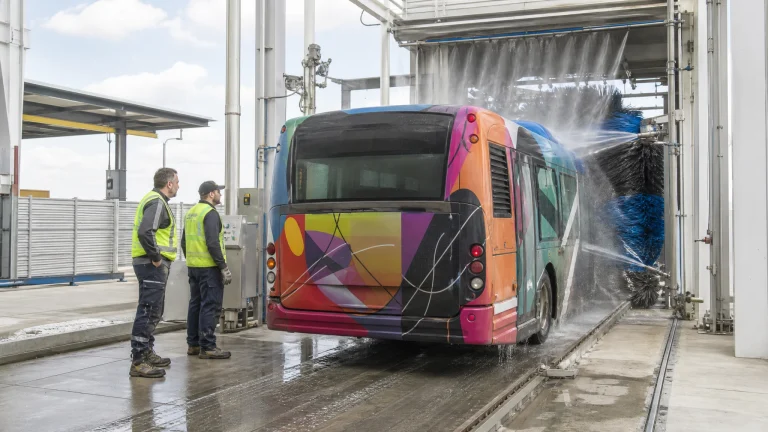
Underbody work concentrates the hazards a wash already has. OSHA classifies wash facilities under SIC 7542 (OSHA), and its alliance with the International Carwash Association, the nonprofit that represents the US car wash industry (ICA), focuses on exactly the risks you find around a chassis wash: slips, trips and falls, hazard communication, and vehicle operation safety (OSHA-ICA alliance). Wet, salt-slick floors combined with moving heavy vehicles is where people get hurt, so pit access, floor drainage and vehicle guidance belong in the specification, not the operations manual.
What to put in the specification
Treat chassis washing as one of the questions you settle before choosing a machine, alongside throughput, ground clearance and arch geometry. Decide the discharge route (sanitary sewer, reclaim, or a permitted discharge) with the local authority early, because treatment level and discharge limits are inputs, not defaults. Coordinate wash frequency with your inspection cycle so a clean chassis supports the report rather than competing with it. For the procurement and sizing angle, our guides on why heavy vehicles need their own wash system, sizing a truck wash for the fleet you actually run and what a fleet should specify in a wash arrangement cover the rest of the brief, and how water recycling works explains the reclaim side in more detail.
Where Europe Makine fits
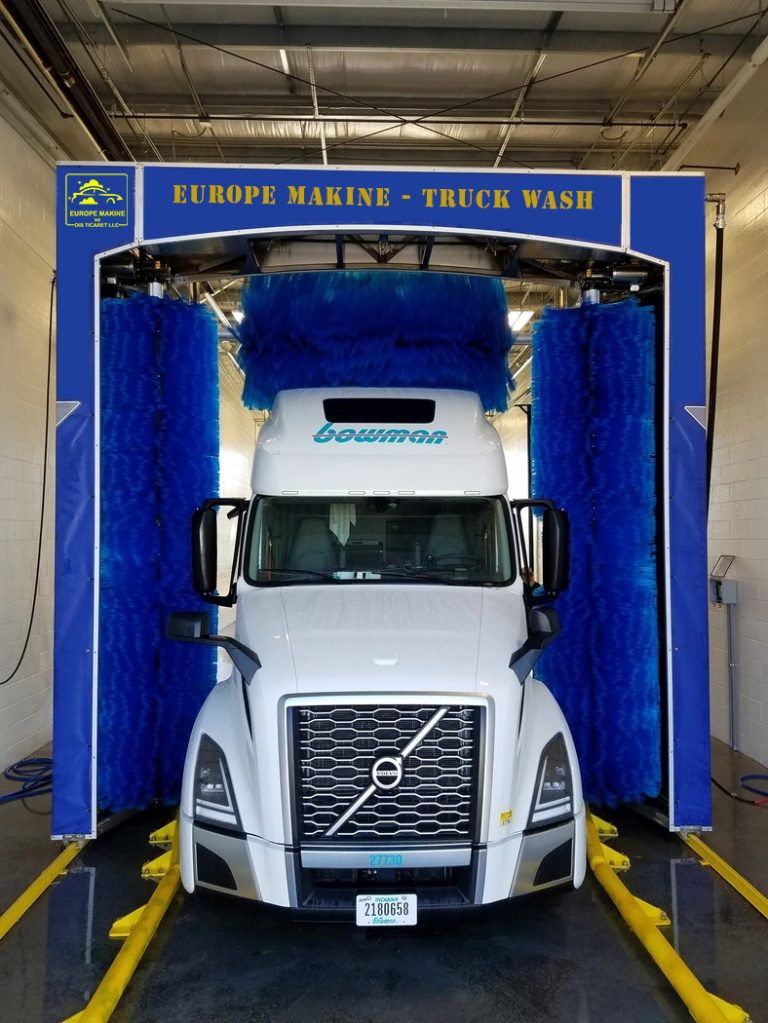
Europe Makine builds heavy vehicle washing equipment, including the SUNRISE W4000/W4700, and delivers turnkey washes where the site, permits, installation and calibration, drainage and crew are handled and the operation is handed over running. The takeaway from this article stands whoever you buy from: raise water handling, discharge and inspection support at the design stage, so the questions are answered in the concrete and the pipework rather than after the wash is built.