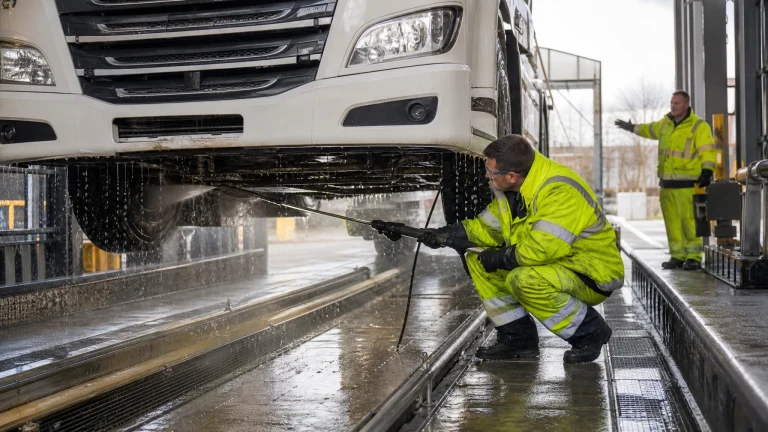
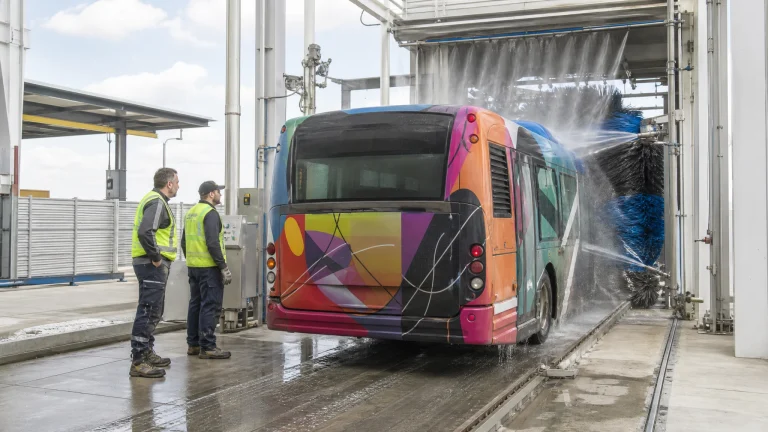
The short answer is that a train wash system is not a bigger car wash. It is a piece of depot infrastructure built around three things that never change: a vehicle that runs to a fixed profile, a stretch of track it cannot steer off, and roof and running gear that must be protected rather than scrubbed. A road-vehicle wash is designed for the opposite situation, a stream of vehicles of unknown size that arrive, stop, and reposition freely. Once you see rail vehicle washing as a plant you specify to a known vehicle, rather than a machine that guesses at each one, most of the design decisions fall into place.
A train is measured in tens of metres, so the wash moves and the train does not stop
A car wash is sized for a single vehicle of four or five metres. A multiple unit can be well over a hundred metres of coupled cars, so there is no bay long enough to hold it. Instead the plant works as a continuous drive-through gantry: a set of arches and brushes that the consist passes through at a slow, constant speed under proximity or signal control, integrated with the depot’s shunting movement rather than a driver pulling in and stopping.
That single change ripples outward. Cycle time is governed by train speed and length, not by a fixed tunnel dwell. Wash quality depends on the consist holding a steady crawl from the first car to the last. And the plant has to be commissioned around the depot’s movement authority, because the wash is one step in a stabling move, not a standalone stop.
You give the supplier the profile, you do not ask the machine to find it
Because rail vehicles run to a known loading gauge, brush position, nozzle angle and arch height can be set to the exact bodyside, ends and roof profile. This is a specification input from you, taken from as-built vehicle drawings, not an adaptive guess made by the plant. Road washes use flexible brushes and pressure jets precisely because they never know what is coming; a train wash should be dialled to the fleet it serves.
The roof is where this matters most. A car roof is a plain panel. A train roof carries pantographs, air-conditioning units, aerials, sensors and hatches, and the wash has to clean around that equipment, not through it. Supply the supplier the as-built roof arrangement and let the arch geometry be set to clear it.
What stays out of the wash is as important as what goes in
Many road washes include underbody and wheel washing. On rail, the underframe, bogies, brake gear and any third-rail contact shoes are safety-critical running gear, not cosmetic surfaces, and they are normally kept out of the automatic wash zone and cleaned under separate maintenance regimes. Scope a train wash as an exterior bodyside, ends and roof wash, and be explicit about the boundary.
The biggest constraint with no road equivalent is overhead line electrification. Any gantry, brush arm or spray bar near live overhead equipment is a safety-critical design and isolation question that needs sign-off from the electrification and infrastructure teams, not just the wash-plant supplier. Treat clearance and interlocking as a design input from the start, verified against your infrastructure standards, rather than something reconciled after the plant is drawn.
The depot chooses the site, not a forecourt
A road wash needs forecourt room for vehicles to queue and manoeuvre. A rail wash needs a straight, level, accessible length of depot track with clearance for maintenance access on both sides, because the train cannot swing around anything. Siting is really about finding the right piece of track and confirming the services reach it, which is the same discipline covered in reading a site before choosing a machine, applied to a fixed rail alignment. Get the survey wrong and there is no repositioning the vehicle to compensate.
Water volume and runoff scale with the surface, and the numbers get large
A train presents both flanks, the ends and the roof over tens or hundreds of metres, so the wetted surface per wash is far greater than a car, and so is the volume of water, detergent and contaminated runoff. In the US, wastewater from cleaning transportation equipment falls under a dedicated set of EPA transportation equipment cleaning effluent guidelines, and washing operations more generally are strong candidates for water recovery and reuse. For a depot, that turns into concrete scoping questions: can your drainage take the peak flow, do you need reclaim and treatment, and what discharge consent applies. Settle those before you settle on a plant, and take any litres-per-wash or recovery-percentage figures from the manufacturer’s datasheet rather than an estimate.
Contamination is different too. Rail vehicles carry brake dust, rail-head deposits, trackside debris and, on diesel and hybrid stock, exhaust soiling. That soiling profile feeds directly into detergent chemistry and into what your rinse water treatment has to remove before discharge.
Metro fleets make the turnaround window the design driver
For a metro wash the constraint is time. High-frequency fleets on short headways come back to the depot in tight windows, so the wash has to fit a stabling and turnaround cycle without becoming the bottleneck. Here, throughput is not a marketing figure, it is whether the plant clears the night’s units before service. It is worth reading what throughput figures actually mean before comparing suppliers, because a rate quoted on an ideal single vehicle rarely survives contact with a real depot movement plan.
Where Europe Makine fits, honestly
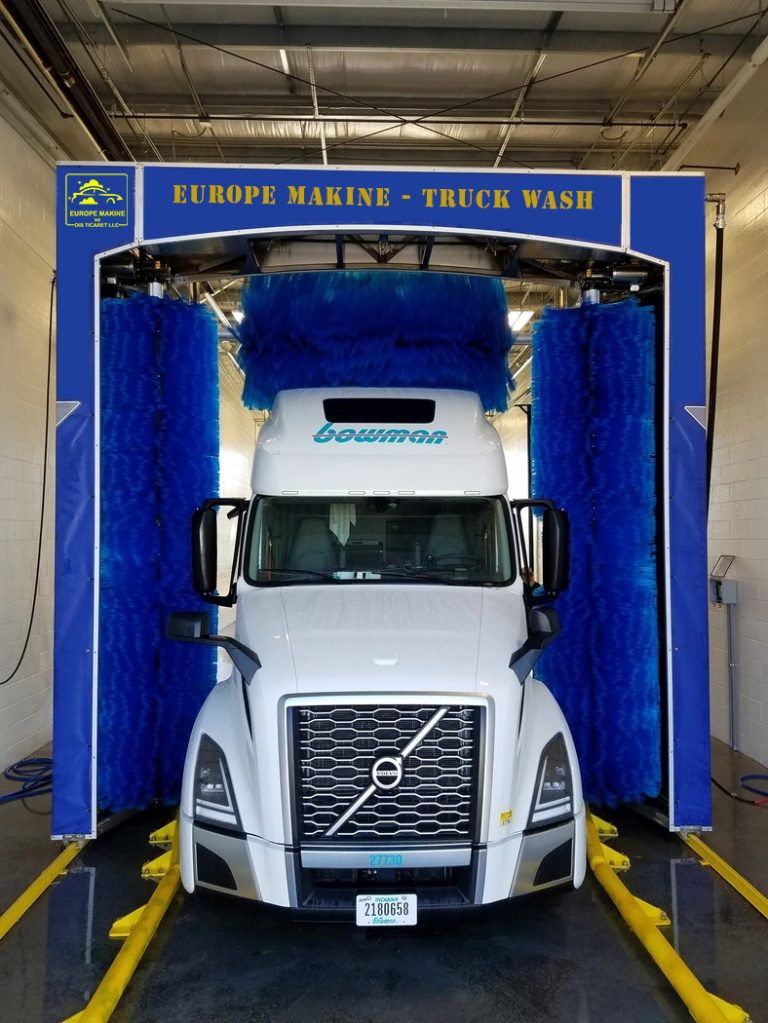
Europe Makine designs and builds wash systems for cars, heavy vehicles and rail vehicles in its own 1,500 square metre facility, with complete turnkey delivery available in the US. Rail systems are engineered to order around the rolling stock, depot road, cycle time, water recovery and site constraints. Europe Makine has delivered a working light-rail wash system in Osmangazi, Bursa; that is a tram reference, not a claim that the company has delivered a metro installation. The same specification discipline applies throughout: measure the vehicle, read the site, size the water and drainage, and build the plant around fixed constraints rather than hoping a generic machine copes.
If you are scoping a rail or heavy-vehicle wash and want that discipline applied to your depot, the next step is a conversation about your vehicle profile, track and services. Tell us about your project and we will tell you plainly what is and is not within our range.