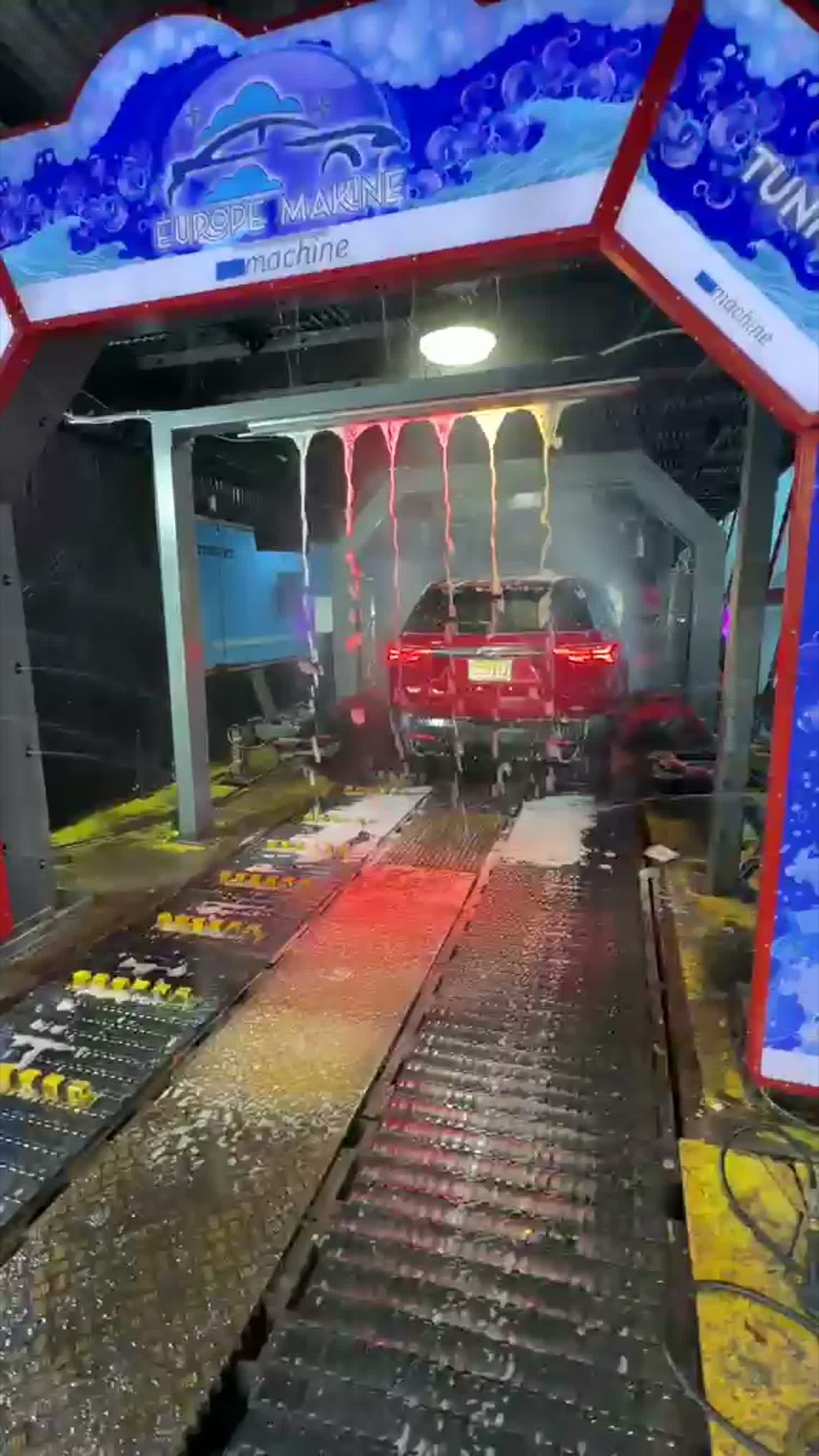
Between delivery and the first paying car, a tunnel goes through five things: local approvals, utilities and discharge sign-off, installation and calibration, crew training and safety, and a supervised trial run followed by handover. That sequence is tunnel startup commissioning in practice. There is no standard number of days for it; what matters is the order of the gates, who normally owns each, and what you should be able to see before you open.
There is no standard timeline, so plan by gates
Many owners ask how long a tunnel car wash opening takes after the equipment arrives. It depends on the site, the local authority and how much was settled before the machines shipped. A published number would be a guess, and a guess is a poor thing to build a loan schedule or a marketing launch around.
A better way to plan is by gates. A gate is a point where something must be true before you move on. Some gates run in parallel, such as permits and installation. Others cannot be skipped, such as training a crew before they work near moving equipment.
The gates are:
- Licenses, zoning and local approvals.
- Water, drainage, discharge and reclaim sign-off.
- Installation and calibration of the tunnel equipment.
- Machine safety and crew training.
- Trial running, soft opening and handover.
Gate 1: licenses, zoning and local approvals
The first thing that stops a first car is usually paperwork, not machinery. The US Small Business Administration has a guide to applying for licenses and permits that frames this as something you complete before you can start doing business. It is general guidance for any business, not a tunnel-specific list, but the principle applies directly.
The SBA also notes that licenses are typically administered by a variety of state and local departments, and that zoning regulations matter when choosing a site (see its San Antonio District guidance). There is rarely one office that signs everything off. You may be dealing with a planning department, a building department, a utility and a health or environmental body, each with its own sequence.
Which permits apply depends on your state, county and city, so ask each authority one simple question early: what must be issued, inspected or signed before this site can open?
What to have in hand before delivery
- A written list of every approval the site needs, with the issuing body next to each.
- The status of each approval: applied for, issued, or conditional on an inspection.
- Any condition attached to an approval, such as a requirement for a final inspection after installation.
Conditional approvals matter most. A permit that depends on an inspection of the finished installation cannot be closed until the installation is finished, so it sits inside your commissioning window rather than before it.
Gate 2: utilities, discharge and reclaim
A tunnel uses water continuously and sends it somewhere. Before the first car, you need to know where that water comes from, where it goes and who has approved that route.
The US Environmental Protection Agency says in its public guidance that commercial car washes are required to properly dispose of wastewater, and that many filter and recycle their water. It gives no single numeric limit that applies to every wash.
Discharge rules are local
An older EPA study of car wash wells, dated September 1999, shows that discharge rules vary by state. It lists options such as discharging to a sanitary sewer or obtaining a groundwater discharge permit, and notes that at least one state bans car wash wells outright. Rules have moved on since 1999, but the point stands: your discharge route needs local approval, and the answer differs by place.
Practically, that means confirming before opening day:
- That the discharge route has been approved by whoever controls it, whether that is the sewer operator or another authority.
- Whether any discharge limits apply to your site and how they will be checked.
- That the drains, pits and pipework on site match what was approved, not what was drawn at an earlier stage.
Plan reclaim into the design
EPA’s WaterSense at Work guidance on vehicle washes says that many commercial vehicle washes have adopted water reclamation technology, and that some water agencies incentivize or require reclaimed-water systems. A second section, on vehicle washing, says reclamation can lower freshwater use per vehicle and lists discharge limits, where applicable, as an input when calculating water use.
If your water agency requires or rewards reclaim, the reclaim system has to be installed, connected and running before you open, and it has to be tested as part of the whole wash rather than on its own. A reclaim tank that is full of clean tap water on day one has not been tested.
Gate 3: installation, then calibration
Installation puts the machine in the building. Calibration makes it wash a car properly. They are different jobs, and confusing them is one of the most common reasons a wash feels finished when it is not.
The work below is described in general terms, to help you ask good questions of whoever is doing it.
Installation
Installation covers positioning the conveyor and the wash and drying equipment, connecting water, power, air and chemical supply, and fixing everything to the building as designed. The result should match the approved drawings. If something had to move on site, the change should be recorded, because an inspector may compare the finished building with the plans.
Calibration
Calibration is where the machine is set up to behave consistently. In general terms, that means checking that the conveyor moves the vehicle as intended, that sensors detect it where they should, that chemical and water supplies are metered and sequenced correctly, and that the dryers and other stations act at the right moment. Exact settings depend on the equipment and the site.
The industry body offers sensible advice here. A Car Wash Magazine piece on the industry’s technology gap suggests writing down your non-negotiables, such as membership workflow, uptime expectations and license-plate-recognition accuracy targets, and not installing everything at once. A Champions Corner article on existing sites advises checking equipment compatibility and choosing modular designs with common components.
Taken together, those two points suggest a useful habit. Decide before delivery what "working" means for your site, then commission in stages so that a fault in one system is not hidden by the others. If you are adding membership or plate recognition, treat them as systems to be proved, not as extras that will sort themselves out after launch.
Gate 4: machine safety and crew training
The crew will work around conveyors, pumps, motors and compressed air. Before they do, the site needs a way of making a machine safe to service, and the people using it need to be trained.
Lockout/tagout
OSHA’s standard on the control of hazardous energy, 29 CFR 1910.147, commonly called lockout/tagout, covers servicing and maintenance of machines where unexpected energization or start-up could injure employees. A tunnel is full of such machines. Clearing a jam, changing a part or cleaning near a moving component are exactly the jobs the standard is concerned with.
OSHA also publishes data on frequently cited standards for car washes (industry code 811192), and lockout/tagout appears among them. Lockout/tagout is a standard car washes are commonly cited for, and a poor thing to leave until after opening.
A recent enforcement example
In September 2026, the US Department of Labor announced citations against a New Jersey car wash for what it described as willfully exposing workers to hazards, with more than $446,000 in proposed fines. The items listed include lockout/tagout devices, noise monitoring and training for employees exposed to noise above 85 decibels.
It shows what an inspector may look at on a wash: whether energy-isolation devices are in place, whether noise has been assessed, and whether staff have been trained. All three can be set up before opening day, and far more easily then than under pressure afterwards.
OSHA also maintains an alliance page with the International Carwash Association, which links to lockout/tagout resources. The agreement dates from November 2005; it is a sensible place to start.
What training should cover
- How to stop the tunnel, isolate it and confirm it is safe before anyone reaches in.
- Who is authorized to service which equipment, and who is not.
- What the normal sound, behavior and layout of the tunnel look like, so that a fault is noticed early.
- What to do when a vehicle stops, a customer leaves a car in neutral incorrectly, or something goes wrong at the entrance.
A competent person should assess your actual equipment and procedures against the standard.
Gate 5: trial running, soft opening and handover
Once the building is approved, the machine is calibrated and the crew is trained, the tunnel needs to run. Not with a paying customer yet, but as a whole system, in the order a customer would meet it.
Dry and wet runs
A run without vehicles shows whether the water, power and chemical systems behave together. A run with test vehicles shows whether the wash does what you wanted. Watch the entrance, the conveyor transfer, each station, the dryers and the exit. Check also what happens when something is deliberately interrupted, because a stopped tunnel with a car in it is a situation the crew must handle calmly.
Soft opening
Some operators open quietly before any public launch, to let the crew practice at real speed with real customers. That is optional. If you do it, keep a short written log of faults and fixes. It becomes the first page of your maintenance history.
What you should hold at handover
- Copies of the approvals and any inspection sign-offs, with conditions noted.
- Confirmation of the discharge and, where relevant, reclaim approvals.
- Operating and maintenance documentation for each machine, in a form the crew can use.
- A record of the training that has been given and to whom.
- A list of any open items, each with an owner and a date.
- A named person to call when something stops working.
The last two matter most. A handover with no open-items list usually means the open items exist but nobody has written them down.
Who owns each step?
The delay between delivery and the first car often comes from the spaces between contractors. The building contractor finishes and leaves. The equipment supplier installs and leaves. The authority inspects on its own timetable. The crew is hired separately. Each party finishes its own part, and nobody owns the sequence.
When you plan your own tunnel car wash opening, write one page that names an owner for each gate:
- Approvals and inspections: who applies, who attends, who receives the sign-off.
- Utilities and discharge: who confirms they match what was approved.
- Installation and calibration: who declares the machine ready, and against what standard.
- Safety and training: who writes the procedures and who trains the crew.
- Handover: who holds the open-items list.
If two gates have the same name next to them, check that the person can do both. If a gate has no name, that is where the delay will be.
Where we fit
We manufacture wash systems, including a conveyor tunnel system, and build turnkey car washes. In a turnkey project, one team secures the site, clears permits, installs and calibrates the machines, hires and trains the crew, and hands over a running operation. That puts several of the gates above under one owner rather than several.
Machines shipped in the US from our Greenacres, Florida base come with door-to-door delivery, free installation and a 12-month warranty. Our conveyor tunnel washes up to 130 cars an hour on a long tunnel and 30 to 60 on shorter lines. Ali’s Car Wash in Ocala, Florida runs on our machines and was built through the same turnkey process.
Whether you use a turnkey builder or manage the gates yourself, the test is the same. For each gate, can you name who owns it and what evidence will show it is closed?