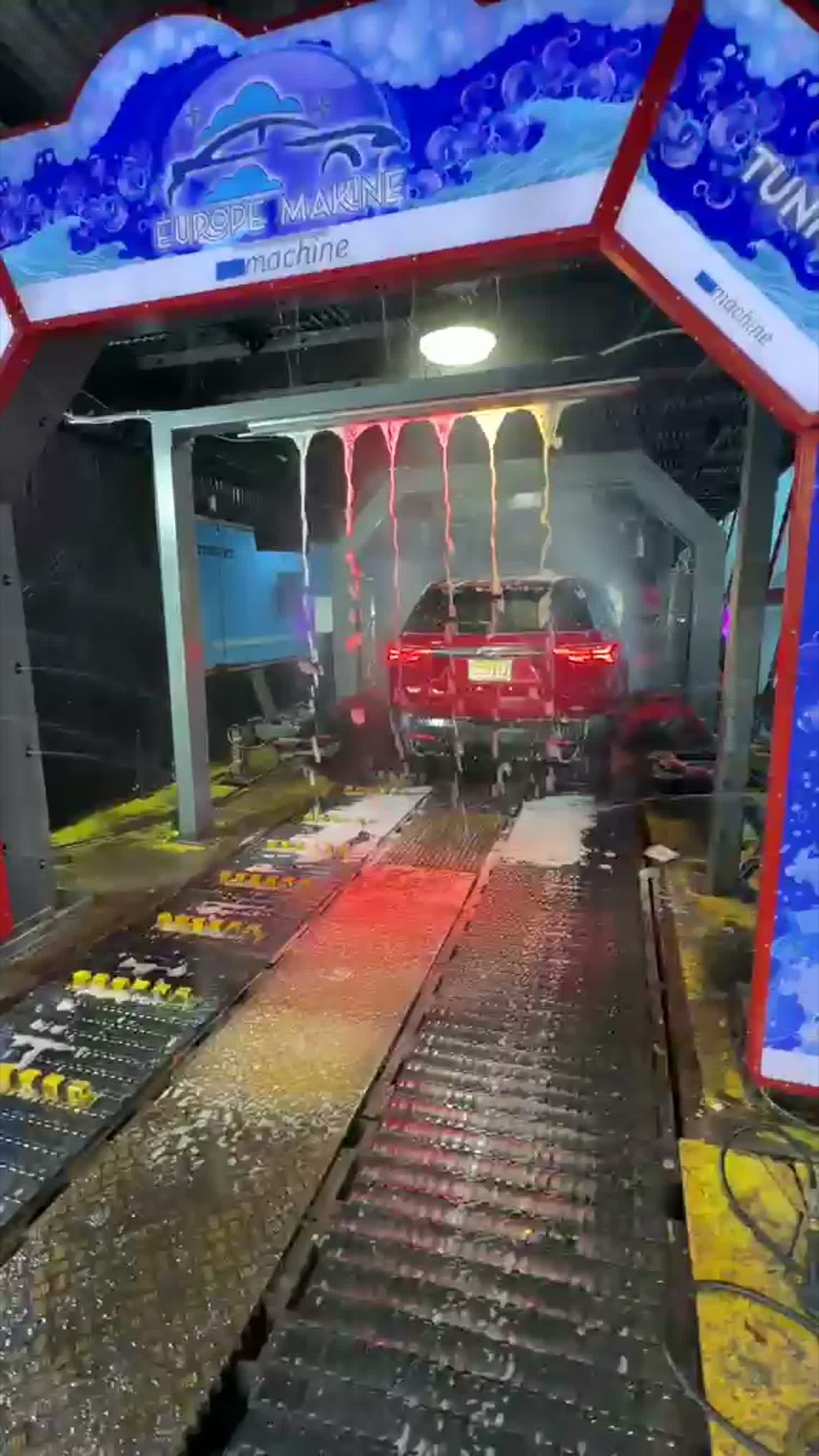
Express tunnel labor has no single answer. Headcount per shift depends on the service model, the site design and how much of the work is automated, so be wary of anyone who quotes an exact figure as fact. The direction is clear: newer express sites are being designed to run with fewer people on site, and one supplier designs its sites for two to four employees on site.
The scale of the workforce
The industry is large enough that staffing is a real operating concern rather than a footnote. According to the Carwash Industry Information page on carwash.org, the professional car wash industry employs more than 220,000 full- and part-time employees at retail stores, and more than 15,000 in car wash equipment, chemical and service-providing companies.
That figure covers every retail wash format, not just express tunnels, so it does not tell you what one tunnel needs. It does tell you that a lot of people work in this trade, and that hiring and keeping them is a shared problem.
Why there is no single number
Headcount depends on a handful of decisions made long before the first car enters the tunnel. Four matter most.
The service model
An express exterior wash and a flex or full-service wash are different labor structures. A recent Champion’s Corner article on carwash.org says the express model created a simpler labor structure and higher vehicle volume. It also notes that flex and full-service sites add interior labor on top of the tunnel, so headcount rises with the service model. The same article describes a large flex site built to deliver a full-service wash in 15 minutes or less, which gives a sense of how much more is going on at that kind of site.
So the first question is what you are asking the crew to do for each customer. Interior cleaning, hand drying and detailing are labor-intensive in a way that an exterior-only tunnel is not.
The site layout
Where the pay point sits, how cars are guided onto the conveyor, how well the entrance can be seen and how the exit is arranged all change how many people you need to cover them. A site where one person can see both the entrance and the pay area needs fewer people than a site where those areas are out of sight of each other.
The degree of automation
Automated pay stations, membership recognition and automatic prep arches reduce the number of tasks that need a person. They do not remove the need for people entirely. Someone still has to watch the tunnel, deal with problems and help customers who cannot work the kiosk.
The hours and the traffic pattern
Traffic is not flat. A site that is quiet at midday and busy after work, or busy on sunny weekends and quiet in the rain, will not need the same crew at every hour. Your own records are the only reliable guide to this, and they matter more than any generic figure.
The jobs that need covering on every shift
Rather than starting from a number, start from the functions. For any express tunnel, someone has to cover each of the following during opening hours. On a lean site, one person may cover several of them at once.
- Entrance and pay point. Greeting customers, helping with the kiosk or membership scanner, and answering questions.
- Prep. Preparing vehicles for the tunnel, where the site offers it, and checking for loose mirrors, antennas or other items that should not enter the tunnel.
- Loading and guiding. Getting each vehicle correctly aligned and into neutral, and keeping the line moving at the conveyor entry.
- Tunnel oversight. Watching for problems in the tunnel, stopping the line when needed and responding to alarms.
- Exit and finishing. Checking cars as they leave, and any hand finishing the site offers.
- Vacuum and site care. Where free vacuums are offered, keeping the area tidy, emptying bins and keeping the lot safe.
- Management. Someone responsible for the shift, who can make decisions, handle complaints and cover absences.
Listing the functions this way helps in two directions. If you are planning a site, it shows where design can take work out. If you are running one, it shows where a person is standing around, and where two people are doing a job that needs three.
What one supplier designs for
One supplier describes a national express franchise model whose sites are designed to function with only two to four employees on site.
That is one supplier’s design target for its own sites, not an average, and it says nothing about which hours it covers or what happens on a busy Saturday. It shows how lean a tightly designed express site can aim to be.
The trend toward leaner sites
The wider message in the trade press is consistent, even if the numbers are not. In The Winning Car Wash Playbook on carwash.org, a speaker says the sites being built today are smaller, faster, more visually striking, and require fewer employees on site. The same article lists leveraging automation to reduce labor dependency as one of four areas where operators can create meaningful returns.
Another industry news item describes a prototype designed for smaller towns, with a smaller land footprint and less staffing required. Leaner sites are a deliberate design goal.
If you are weighing up a new build, staffing is partly a design decision. The layout and equipment you choose today fix a large part of the labor you will need for years.
Equipment has to support the labor model
The Champion’s Corner article also says the equipment has to support the labor model instead of forcing employees to work around it. That is a useful test when you are choosing or reviewing a tunnel.
In practice, it means asking questions such as these:
- Can one person see the whole tunnel entrance and the conveyor from where they stand, or do they need to keep walking?
- When something goes wrong, can the person on duty find out what and where from a clear display, or do they have to hunt through the tunnel?
- How often do operators need to step in to fix a routine issue, such as a vehicle that is out of position or a sensor that needs resetting?
- Is routine cleaning and maintenance quick enough to be done between shifts without taking someone off the line at a busy time?
- Are the controls simple enough for a new starter to learn quickly, or do they depend on one experienced person?
Equipment that causes frequent small stoppages will consume labor. A person who spends part of every hour clearing jams is a person who is not greeting customers. When you compare machines, ask how many hands a tunnel’s throughput needs, and what those hands do all day, as well as how many vehicles an hour it can handle.
People still matter in an automated wash
None of this means staff are optional. The Power of People on carwash.org reports that 21 percent of consumers say staff are part of what makes a wash great, and that 7 percent say a helpful employee is the single thing that separates an average wash from a great one.
They suggest that when you cut headcount, the people who remain carry more of the customer experience. A lean crew that is well trained and well organized can serve customers well. A lean crew that is overstretched cannot.
The same article treats hiring, training and retention as a strategy rather than a soft cost, and says one of the first metrics it works on with operators is turnover rate. Measure your own turnover. High turnover in a small crew is especially costly, because every departure removes a larger share of your experience and every new starter needs training before they can work independently.
Training and safety are part of staffing
Headcount is only part of the picture. Every person on the crew needs to be trained for the work they do, and some of that training is a legal requirement.
OSHA’s lockout/tagout standard, 29 CFR 1910.147, requires an energy control program made up of procedures, employee training and periodic inspections. It applies before servicing or maintenance where the unexpected energizing of a machine could injure employees. The standard also requires retraining when job assignments or equipment change. For a tunnel, that has practical consequences:
- anyone who clears a jam, adjusts a component or cleans inside the tunnel needs to know how to isolate the machine safely first;
- a new starter should not be sent into the tunnel before they have been trained;
- if you change equipment, add a machine or move people to different jobs, you need to check whether retraining is due.
OSHA’s enforcement activity shows that this is not a theoretical point. A September 2026 OSHA news release says the agency cited a New Jersey car wash service for willfully exposing workers to hazardous energy, with $446,864 in proposed penalties. The release also cites noise-program and training violations. For staffing, a crew needs lockout/tagout and noise training, and the time for that training has to be built into the schedule and the budget.
That has a knock-on effect for small crews. If only two or three people are on site, each of them needs to be competent in the safety procedures, because there may be nobody else to ask. It is a good reason to treat training hours as part of your labor plan rather than something squeezed in around the busy times.
Thinking about labor cost
You will want to relate headcount to cost. The Bureau of Labor Statistics publishes occupational wage data through its Occupational Employment and Wage Statistics program. It is a sensible place to check typical pay for broad occupations in your region.
The nearest broad occupation code, Automotive and Watercraft Service Attendants, is not specific to car wash tunnel crews, and its description centers on fueling and servicing vehicles. Local pay for your own crew will depend on your market, your hours and what other employers nearby are offering. Check the latest published data and compare it with what you pay before you build any forecast on it.
A simpler and more reliable discipline is to track your own labor hours against your own wash counts, shift by shift, for a few months. Over time that gives you a figure that belongs to your site, which is worth far more than a national average.
Questions to ask before you set a crew size
Answer these questions for your own site and you will have a much clearer idea of what a shift needs.
- What is the service menu? Exterior only, or exterior with interior work? Every interior service adds labor that the tunnel itself does not need.
- What do the traffic records show? When are the real peaks, and how long do they last? A crew sized for the peak will be underused the rest of the day, so consider whether some roles can flex.
- Who covers breaks and absences? A site designed for the smallest possible crew has no slack. Decide in advance what happens when someone is sick or leaves.
- Which tasks could the site design remove? Better sight lines, clearer signage and a simpler entry can reduce the number of people needed to guide customers.
- What does the equipment demand? Count how often a person has to intervene, and what it takes to do so safely.
- How will you train, and how often? Include lockout/tagout and noise training, and plan for retraining when equipment or job assignments change.
- How will you keep people? If turnover is high, find out why before adding more heads to cover the gap.
Common mistakes in express tunnel staffing
A few patterns come up repeatedly when a crew is too thin or too large.
Copying someone else’s headcount. A figure from another site, or from a brochure, reflects that site’s layout, menu and traffic. It may not suit yours.
Cutting the crew before fixing the cause of the work. If people are busy because the equipment stops often or the layout forces them to walk, removing people will not fix it. Fix the cause first.
Treating the manager as spare capacity. On a small crew the person in charge often ends up covering every gap, which leaves no one to manage. That is how problems stay unresolved.
Leaving training until the site is busy. New starters who learn only by watching are more likely to make mistakes, and the safety obligations above do not wait for a quiet week.
Ignoring the customer’s view. A lean crew is fine as long as customers still feel looked after. Given what the Power of People article reports about how consumers see staff, a helpful face at the entrance is not a luxury.
Where we fit
We manufacture wash systems and build turnkey car washes. Our conveyor tunnel system washes up to 130 cars an hour on a long tunnel and 30 to 60 on shorter lines. Throughput tells you how fast cars can move; how many people that needs depends on the points above.
The turnkey offer handles the labor question for you: we secure the site, clear permits, install and calibrate the machines, hire and train the crew, and hand over a running operation. Ali’s Car Wash in Ocala, Florida runs on our machines and was built through that turnkey process; it is open to the public if you want to see a working site. Machines ship door to door with free installation and a 12-month warranty, and our US base is in Greenacres, Florida. We have more than 30 years of manufacturing experience and a 1,500 square meter production facility.