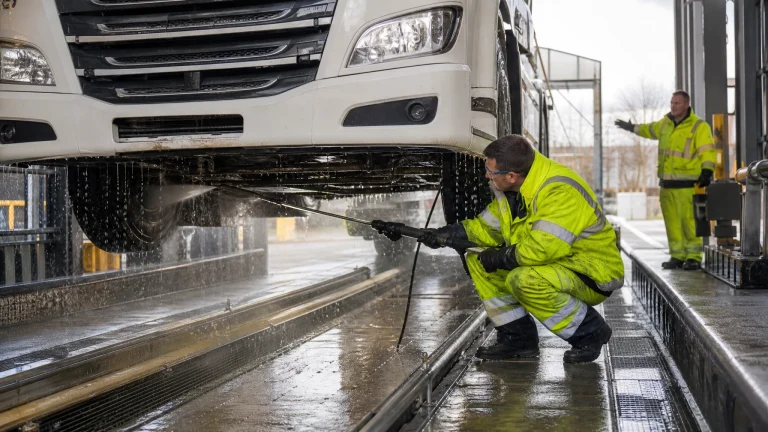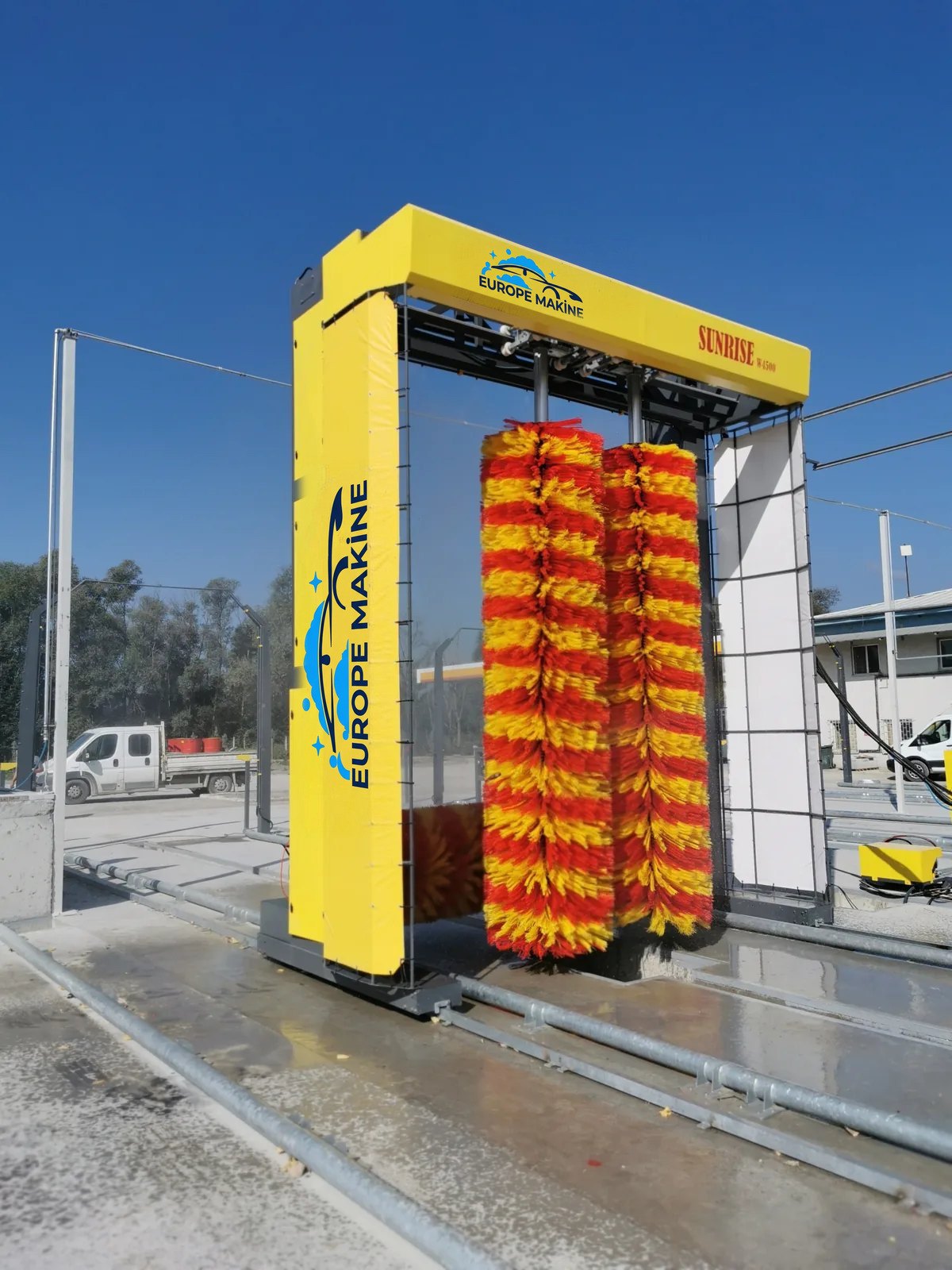
In a gantry wash system, you drive the vehicle into the bay and stop. The vehicle then stays parked for the whole wash, while a moveable gantry carrying the sprays or brushes does the work around it. That is the entire idea, and it is why the same machine type is also called a rollover or an in-bay automatic. Everything else in this article is a closer look at what that means in practice, for cars and for heavy vehicles.
We have kept to what the sources support. The US Environmental Protection Agency (EPA) describes this category clearly, but it does not publish the exact travel pattern of a gantry, and neither do we claim one. Where a detail depends on the manufacturer and the model, we say so.
The short answer: the equipment moves, the vehicle does not
The EPA’s WaterSense at Work guide sorts vehicle washes into three types: conveyor, in-bay automatic and self-service. In its section on vehicle washes, it defines the in-bay automatic as a wash in which a stationary vehicle is cleaned by sprays or brushes mounted on a moveable gantry.
The guide sets this against the conveyor type, where the vehicle moves along a conveyor under stationary arches. The difference is simply which part travels. In a gantry wash, the vehicle is fixed and the machine travels. In a conveyor tunnel, the machine is fixed and the vehicle travels.
While the vehicle sits still, a series of nozzles and/or brushes completes either a friction wash or a frictionless wash. The EPA says this in both its 2023 vehicle washes section and its vehicle washing section.
Why you will see so many names for the same machine
If you are searching for this equipment, you will meet several terms. They overlap, and it helps to know which ones mean the same thing.
- Gantry: the moving frame that carries the washing equipment over the vehicle.
- Rollover or roll-over: the same machine, named for the way it rolls over a parked vehicle.
- In-bay automatic: the neutral category term used by the EPA. The International Carwash Association (ICA) uses "in-bay automatic (or roll-over)" for the same category on its industry information page.
The EPA also notes that terminology and technology descriptions may vary by manufacturer. So when two suppliers describe their machines differently, check what the machine physically does before assuming they are different products.
What about "drive-through"?
"Drive-through truck wash" is a common search phrase, but it is not a separate machine type in the EPA or ICA classification. In practice it is used loosely, and it can mean two different things.
- You drive into a bay, stop, and the gantry moves. This is a rollover, even though you did drive in.
- You drive onto a conveyor or a guided track and the vehicle is carried through fixed equipment. This is the conveyor, or tunnel, type.
If you are specifying a wash for a fleet, ask which of the two the supplier means. The answer decides the space you need, how vehicles queue, and what you can do when something stops working.
What is mounted on the gantry
The gantry is a carrier. What it carries is a matter of design. According to the EPA, the vehicle is washed by sprays or brushes on the gantry, and the equipment varies by manufacturer. Three variations are worth knowing about.
- Friction equipment: brushes make contact with the vehicle as part of the wash.
- Frictionless equipment: nozzles complete the wash without brush contact.
- Both on one gantry: the EPA notes that some systems let the customer choose friction or frictionless equipment mounted on the same gantry.
We make no claim here about which approach cleans better or is gentler on paint. The sources we rely on do not make that comparison, and the answer depends on the vehicle, the soil, the chemistry and the maintenance of the machine. It is a decision to make with your own vehicles and your own site in mind.
How the machine knows where the vehicle is
A parked vehicle is only useful to a gantry if the gantry knows roughly where the vehicle begins and ends. The EPA says most in-bay automatic equipment can incorporate sensors that determine vehicle length. Its stated benefit is water saving on shorter vehicles, because the machine does not need to treat a short vehicle as a long one.
The same guide advises that any vehicle-presence sensors be properly set up. This is a practical point. A sensor that is out of position or poorly calibrated does not fail loudly. It can quietly waste water, or leave part of a vehicle unwashed, and nobody notices until a driver complains.
We will not describe sensor types or detection logic beyond this, because the research behind this article does not cover them. If you are evaluating a particular machine, ask the supplier how it detects vehicle length and presence, and how that is calibrated at installation and checked afterwards.
How the wash level shapes the cycle
A gantry does not run a single fixed programme every time. The EPA states that, in both conveyor and in-bay automatic washes, the cycles and how long they run depend on the wash level the customer selects. A basic wash and a premium wash are different sequences with different run times.
For a public car wash, that choice is made by the customer at a pay station. For a fleet depot, it is more often a setting you decide centrally: a quick rinse for vehicles that come back lightly soiled, a fuller sequence for those that do not. The principle is the same. The gantry follows the selected programme, and the programme decides how long the vehicle occupies the bay.
How soap and rinse are kept apart
Behind the moving frame is plumbing, and the plumbing differs by design. The EPA describes two approaches among others.
- Some designs use one set of nozzles for all wash cycles and empty the lines between soap and rinse.
- Others use a manifold that keeps wash and finish products in separate lines from the rinse water.
This matters if you plan to look at water and chemical use. A machine that empties its lines between stages behaves differently from one with separate lines, and neither description is a verdict on quality. It is simply another reason to ask the supplier for a plain account of how the machine is plumbed, rather than relying on a brochure heading.
Gantry or tunnel: where the vehicle moves
Understanding the gantry is easier when you hold it against the alternative. The two types suit different situations, and the sources give a clear basis for comparing them in principle.
In a gantry wash
- The vehicle drives in and stays parked.
- The equipment moves along the vehicle.
- One bay holds one vehicle at a time, so the bay is occupied for the whole cycle.
In a conveyor tunnel
- The vehicle moves along a conveyor under stationary arches.
- Several vehicles can be in different stages of the wash at once.
- The layout is longer and fixed, because the vehicle needs a path through the equipment.
For a fleet, the question is usually less about technology than about flow. If vehicles arrive in a steady stream and you want them processed one after another along a line, a tunnel fits that pattern. If vehicles arrive in smaller numbers, or are different sizes, a bay that handles one vehicle at a time can fit a more modest site. We are not ranking one above the other here, because the right answer depends on your own volumes and your own land.
Gantry truck wash and rollover truck wash
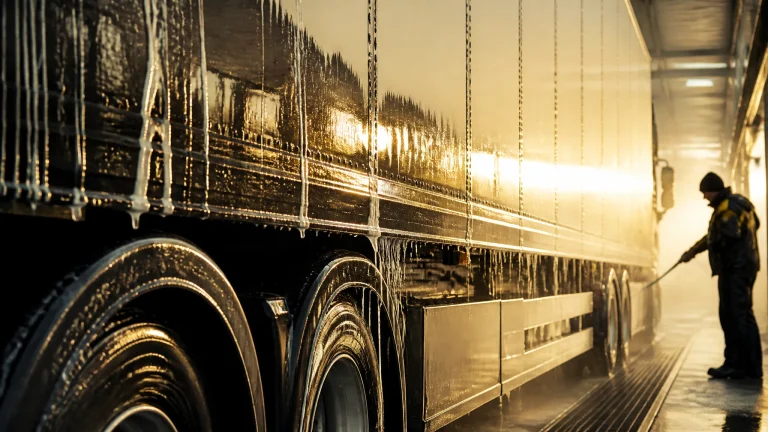
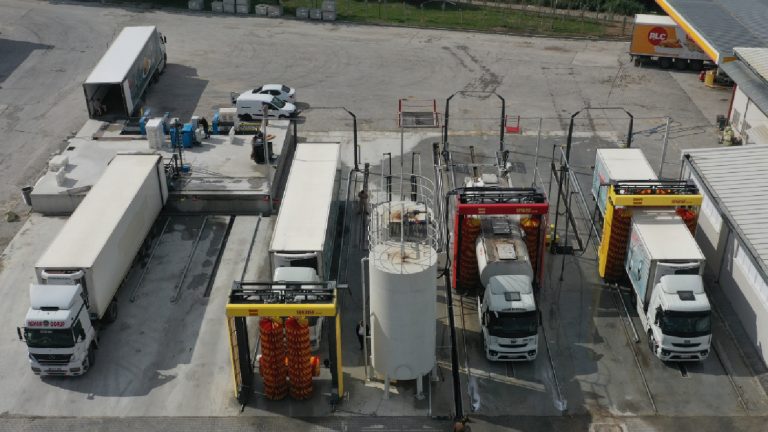
Most of the description above comes from guidance written with car washes in mind, but the machine type extends to larger vehicles. The EPA says similar washing equipment is found at larger facilities that clean heavy-duty trucks and buses. So a gantry truck wash or rollover truck wash is the same basic concept at a larger scale: the truck or bus stops, and the equipment travels along it.
The approved sources do not describe how a truck-specific gantry travels or what its limits are, and we are not going to guess. We will not state maximum vehicle height or length, water volumes, cycle times, or brush and chemical types. If you run a mixed fleet of vans, trucks and buses, those numbers matter a great deal, and you should get them in writing from any supplier for the specific model, not from a general article.
On the product side, Europe Makine manufactures the SUNRISE W4000/W4700 heavy vehicle wash, which is the machine we would point to for readers searching on a gantry truck wash or rollover truck wash. We keep the description at that level deliberately.
What published throughput figures actually tell you
Throughput is where gantry machines are most often misread. A parked vehicle takes the bay for its whole cycle, so the number of vehicles per hour is set by cycle length and by what happens before and after the wash, such as driving in, stopping and driving out. A brochure figure is only useful if you know what it includes.
Europe Makine publishes these figures for its machines:
- The Acrobat 2X, a touchless rollover, washes 3 to 5 vehicles per minute of operation time.
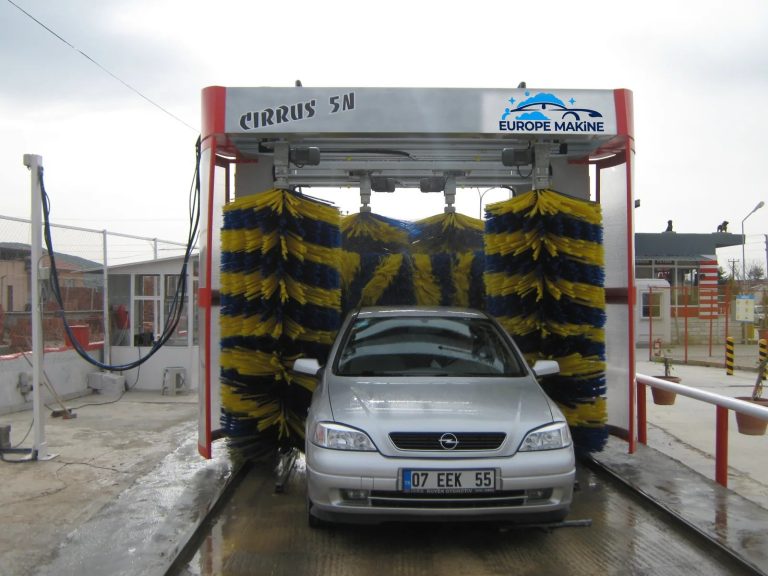
- The Cirrus 5N, a five-brush rollover, averages 24 to 32 vehicles per hour wash-only, or about 14 with drying.
- The conveyor tunnel system washes and dries 30 to 60 vehicles per hour.
Notice the different bases. The first figure is quoted per minute of operation time, the second is per hour and separates wash-only from wash plus drying, and the third includes drying. When you compare machines, make sure you compare like with like, and ask what the stated time includes. The drying line in the Cirrus 5N figures is a good example: including drying brings the average down to about 14 vehicles per hour.
Maintenance and safety around moving equipment
A machine that travels over a vehicle has large moving parts, stored energy and several power sources. People who service it need a disciplined way to make sure it cannot move while they are working on it.
OSHA’s page on the control of hazardous energy (lockout/tagout) says that proper lockout/tagout practices safeguard workers from hazardous energy releases. It also points to OSHA’s Machine Guarding eTool. For a gantry, that means maintenance should follow lockout/tagout practice before anyone goes near the moving frame, the drive or the brushes.
We have not cited specific regulation numbers, and we are not aware of an OSHA or EPA rule written specifically for gantry or truck washes. Your own safety procedures and local requirements still apply, and you should confirm them with a qualified adviser rather than relying on this article.
A simple routine helps. Agree who is allowed to isolate the machine, how it is isolated, and how the team confirms it is safe to work. Write that down at the commissioning stage, not after the first fault.
Water use in an in-bay automatic wash
Because a gantry wash handles one vehicle at a time in a single bay, water use is easy to picture and easy to measure per vehicle. The EPA’s guidance gives a reference point: it recommends limiting fresh water use in retrofitted in-bay automatic systems to 40.0 gallons per vehicle.
It also says in-bay automatic washes can benefit from water reclamation, and that a reclamation retrofit needs a feasibility check first. The vehicle washing section adds a design point: an in-bay water reclamation system must be designed to separate contaminated water, because there is typically only one wastewater collection pit.
In plain terms, you cannot simply add a recycling unit to any bay. The layout of the pit and drains decides what is practical. Raise this early, before you finalise a bay design.
How common is this machine type?
A short note on scale, because it explains why the category is so familiar. The ICA cites a third-party study commissioned in 2020, which estimated about 17,500 conveyor, 29,000 in-bay automatic (roll-over) and 16,250 self-service car washes in the US. Treat these as 2020 estimates rather than current counts.
The ICA also notes that in-bay and self-service sites often have no employees, or are classed as part of a gas station or convenience store. That is one reason such counts are hard to pin down. The same ICA page gives a figure of 50,000 in-bay automatic or roll-over locations in Europe (EU), though the page carries no date for that number. Both figures are on the ICA’s industry information page.
Questions to ask before you choose a gantry machine
When you are comparing machines, the movement of the gantry is less important than the answers to a handful of practical questions. These are useful whether you run a public wash or a depot.
- What does the stated cycle time include? Wash only, or wash plus drying, and does it include driving in and out?
- How does the machine detect vehicle length and presence? And how is that checked after installation?
- How is the plumbing arranged? Are lines emptied between soap and rinse, or kept separate?
- Can friction and frictionless equipment be offered on one gantry? And which does your vehicle mix call for?
- What are the exact limits for your largest vehicle? Ask for height, length and weight limits in writing.
- How will you isolate the machine for service? Make sure lockout/tagout is part of the handover.
- What are the water and drainage requirements? Include whether reclamation is realistic for your pit and drain layout.
A supplier who can answer these plainly, for the exact model you are considering, is worth more than one who describes the gantry in general terms.
Where Europe Makine fits
Europe Makine manufactures five wash systems: the Acrobat 2X touchless rollover, the Ephesus three-brush rollover, the Cirrus 5N five-brush rollover, a conveyor tunnel system, and the SUNRISE W4000/W4700 heavy vehicle wash. The company has more than 30 years of manufacturing experience and a 1,500 square metre production facility, and it exports to markets including Israel, Germany, Poland, Italy, Romania, Azerbaijan and the UAE. It has a US base in Boca Raton, Florida. The machines are not made in the USA.
The company also builds turnkey car washes, covering the site, permits, installation and calibration, crew hiring and training, and handover of a running operation. Ali’s Car Wash in Ocala, Florida runs on Europe Makine machines, was built through that turnkey process, and is open to the public, so you can see a working example.