There is no published rule, formula or standard that sets tunnel wash conveyor length. The length of an automated car wash tunnel is a design decision made by the operator and the equipment supplier, shaped by what the wash needs to do and the site it has to fit. The sourced examples below run from about 91 feet of conveyor in a compact format to a 140-foot tunnel, and they show a range, not a norm.
This article explains what a conveyor tunnel is, what drives its length, which dimensions the published figures actually refer to, and what length does and does not change.
What a conveyor tunnel is
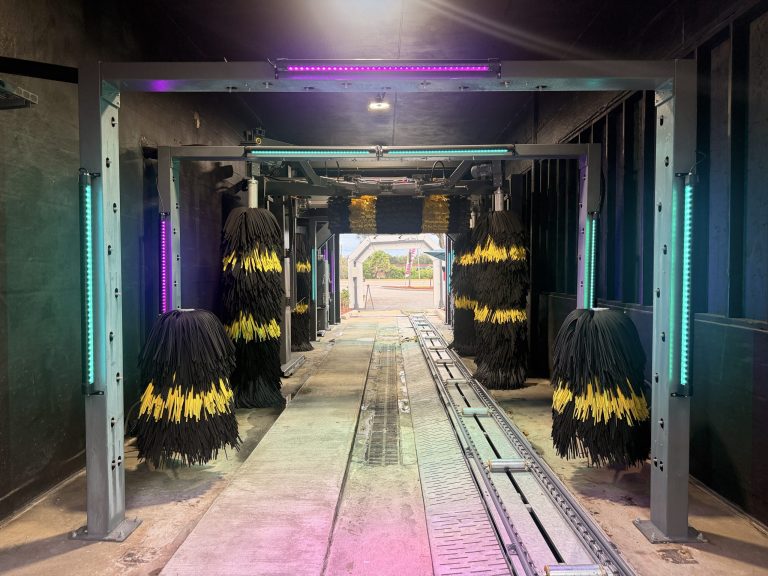
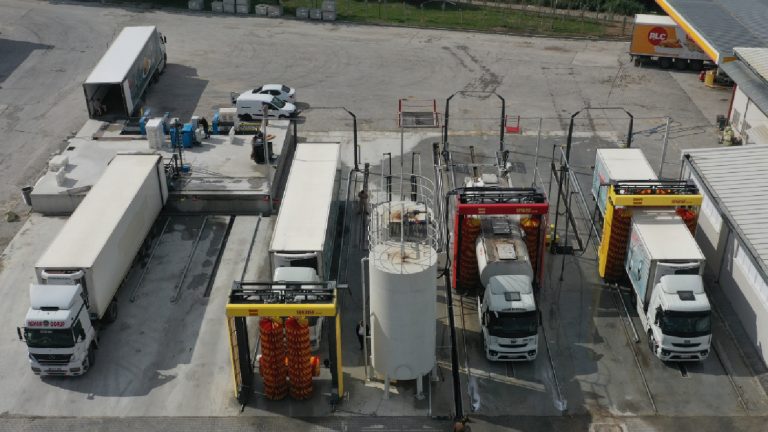
The US Environmental Protection Agency describes conveyor systems in its WaterSense at Work guidance on vehicle washing. A conveyor belt pulls vehicles through a washing tunnel made up of a series of spray arches and/or washing cloths. Depending on the site, the customer either stays in the vehicle or waits outside. In some states, occupants must wait outside during the wash. Conveyor sites may use friction or frictionless washing.
The EPA’s vehicle washes section groups washes into three types: conveyor, in-bay automatic and self-service. In a conveyor system, the wash cycles and how long they run depend on the level of wash the customer selects.
That description already hints at why length varies. A tunnel is a sequence of stations, and the vehicle moves past each one on the conveyor.
No standard length exists
The research behind this article found no US federal rule on tunnel length. It also found no sourced minimum or maximum, no standard length by wash type, and no feet-per-vehicle formula. Any article that gives you a single correct figure is presenting an opinion as a rule.
Local zoning, building and permitting requirements will apply to your project, but this research did not find any that are specific to tunnel length. Check them with the authorities that cover your site.
What shapes the length in practice
The following points are reasoning from how a conveyor tunnel is built, not sourced rules. They are a useful way to frame the decision.
- The wash menu. Because the cycles depend on the wash level the customer selects, a tunnel that offers more steps has more stations to place along the conveyor.
- The equipment you choose. Spray arches and washing cloths each take space. Friction and frictionless approaches use them in different mixes.
- Drying and finishing. Whatever happens after the wash also sits along the line, or in a separate area beyond it.
- The entrance and exit. Loading space before the tunnel and exit space after it are part of the site plan even when they are not part of the tunnel itself.
- The plot and building. The land, its shape and any existing structure can limit the answer before the wash menu does.
None of these gives a length on its own. They are the inputs to a layout, and the layout gives the length.
Real US tunnels: what each number measures
The examples below come from the trade body, the International Carwash Association, through its news and magazine pages. They are illustrations, not an industry average. Note also that the figures measure different things, so they cannot be compared directly.
- Mango Express, West Chicago, Illinois. CAR WASH Magazine describes it as a 110-foot micro express wash with a conveyor length of 91 feet. Here the 110 feet refers to the wash and the 91 feet to the conveyor.
- All American Express, California. In its announcement of a new location, the operator describes a 130-foot tunnel with dual conveyor belts and multiple entrance lanes. It also says the wash runs in under three minutes. That is the operator’s own claim.
- Splash Car Wash, Geneva, New York. Splash reports a 140-foot tunnel.
- Raceway Car Wash, Fontana, California. In the news of its acquisition, it lists a 120-foot express tunnel.
Read together, they show a spread of roughly 91 feet of conveyor to 140 feet of tunnel. Because some figures describe the conveyor, some the building and some the tunnel, the sensible habit is to ask which dimension is being quoted before you compare any two sites.
What length changes: water reclamation
The only length-related effect that the EPA states directly concerns water. Its vehicle washing guidance says conveyor facilities are good candidates for reclamation systems, because the length of the tunnel allows wash wastewater to be separated easily from higher-quality rinse water.
In plain terms, a longer run gives you more room to keep the dirtiest water apart from the cleanest. If you plan to reclaim water, tunnel layout is part of that conversation from the start, not something to add later.
What length does not tell you: throughput
It is tempting to assume that a longer tunnel means more cars per hour. The research does not support that. It found no sourced conveyor speed, no dwell time per foot and no cars-per-hour figure tied to length. A longer tunnel could hold more vehicles at once, but how many cars an hour you wash also depends on how quickly you load them, how fast the conveyor runs and how long each vehicle needs at each station. Those are the figures to ask a supplier for.
The conveyor type may matter as much as the length. In a case story on transforming existing sites, the supplier AVW says a dual belt conveyor offers smoother loading and less risk of vehicle damage than chain-and-roller systems. It also says belt conveyors help operators scale volume without scaling downtime. These are the supplier’s claims, not established general facts, but they point at a useful question: how cars enter the tunnel can limit a queue as much as how far they travel in it.
Questions to settle before fixing a length
- Which wash levels will you offer, and which stations does each one need?
- Will you use friction, frictionless or a mix?
- Do you plan to reclaim water, and how will the tunnel layout support it?
- Where will cars queue, load and leave the site?
- Which dimension is a supplier quoting: the conveyor, the tunnel or the building?
- What conveyor speed and loading method will the supplier’s throughput figure assume?
If you can answer these, the length follows from the layout rather than from a number someone else’s site happened to use.
Where Europe Makine fits
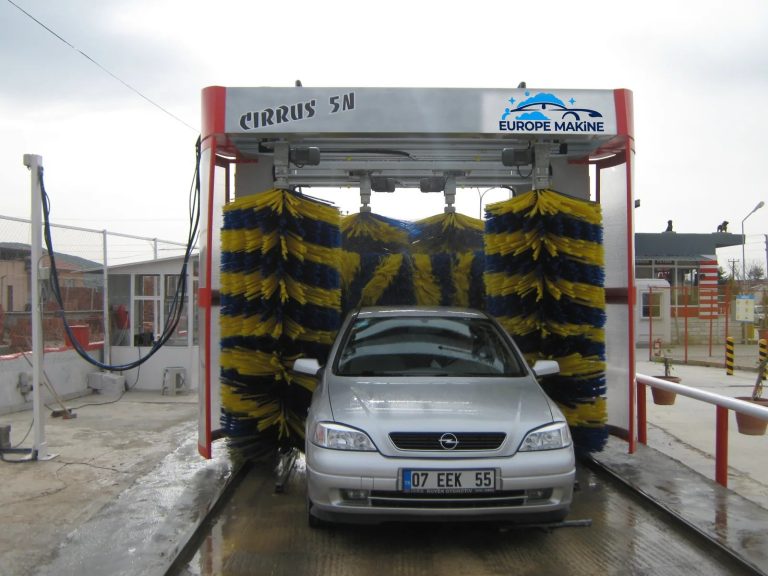
Europe Makine manufactures five wash systems, one of which is a conveyor tunnel system. The company states that the conveyor tunnel washes and dries 30 to 60 vehicles per hour. For comparison, it gives 24 to 32 vehicles per hour wash-only for its Cirrus 5N rollover, or about 14 with drying. It also builds turnkey car washes, from securing the site and clearing permits to installing and calibrating the machines and training the crew. Its US base is in Boca Raton, Florida. No tunnel length is quoted here, because none has been supplied for this article. Ask any supplier for the length together with the throughput it is designed to deliver.