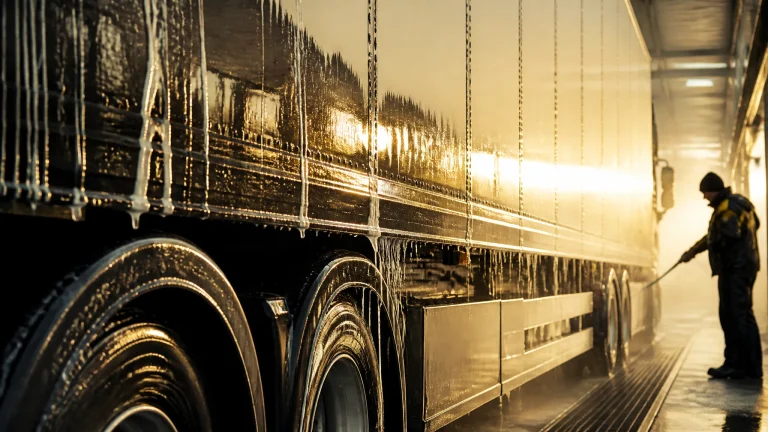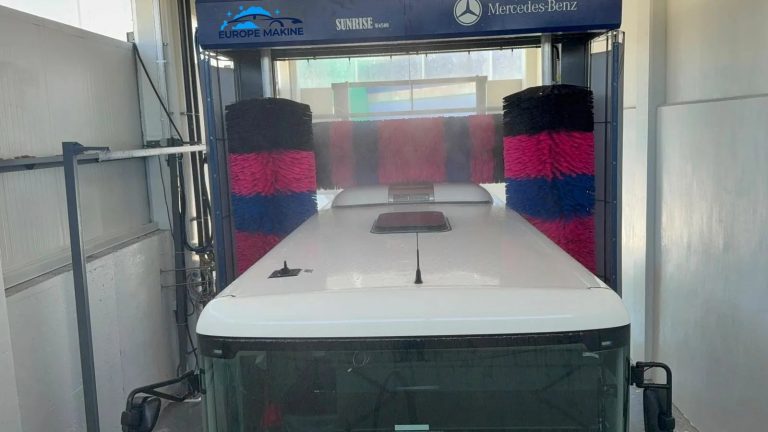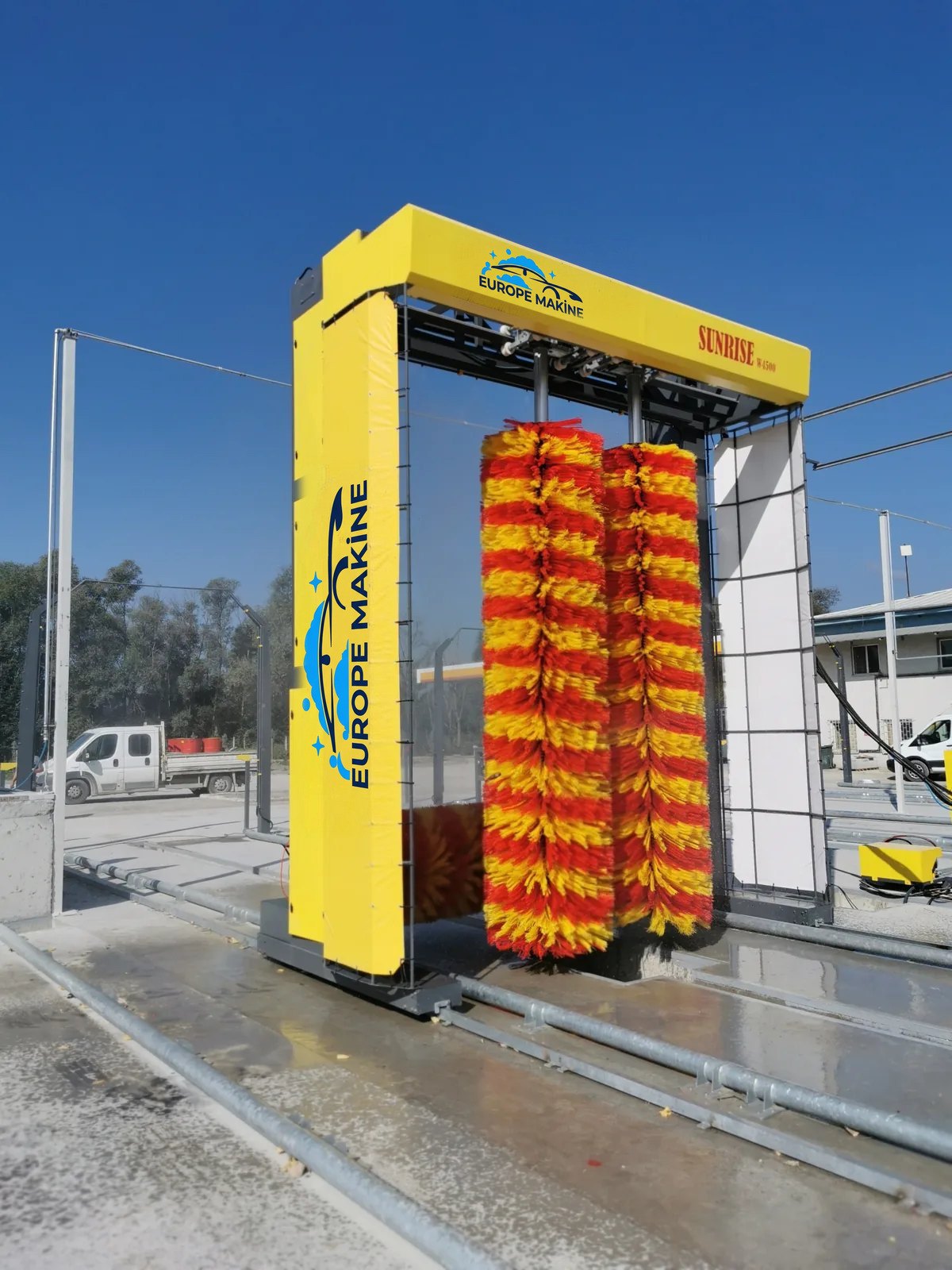
A good bus depot wash does three things at once. It suits the shape of your buses, especially the mirrors and the roof. It keeps the wash water inside the rules that apply to your site. And it finishes the whole fleet inside the window between the last bus coming in and the first bus going out. If any one of the three is left to chance, the wash becomes the bottleneck of the depot rather than a routine task at the end of the shift.
This article walks through each of those problems in turn. It is written for depot managers, fleet engineers and transit procurement staff who are weighing up a bus wash system, whether for a new depot, a renovation or a replacement. It does not give prices, dimensions or throughput figures, because those depend on your fleet and your site and should come from the manufacturer in writing.
Treat the depot wash as three problems, not one
Most disappointing depot washes were specified as a single item: a machine that washes buses. In practice the machine is only one part of a system that has to cope with a vehicle that is tall, wide and fitted with equipment in awkward places, a water stream that regulators care about, and a schedule that has no slack in it.
It helps to separate the questions before you talk to any supplier:
- Vehicle: what are the mirror arrangements, roof profile and roof-mounted equipment across every bus type you run, now and over the next fleet renewal?
- Water: where does the wash water go, which permits apply, and could you reclaim part of it?
- Time: how many buses must be washed in the overnight window, and what else competes for the same lane, staff and yard space?
Each answer limits the others. A machine that handles tall buses well but needs a long cycle may not suit a short overnight window. A reclaim system that saves water may need floor space your building does not have. Settling these together, early, is cheaper than fixing them after installation.
Mirrors: the first thing a bus wash has to respect
On a bus the mirrors are often the widest and most exposed parts of the vehicle, and they are fragile and costly to replace. Whatever the wash type, mirror handling is where a poorly matched system causes damage, complaints and downtime.
We have no approved source giving mirror dimensions or protrusion limits for transit buses, so this article gives none. What matters is that you gather your own fleet data and put specific questions to the manufacturer.
What to find out about your own fleet
- Which mirror arrangements are fitted across the fleet, and whether older and newer buses differ.
- Whether any mirrors are heated, powered or fitted with cameras, and whether those fittings tolerate brush contact or high-pressure water.
- Whether drivers are expected to fold or retract mirrors before entering the wash, and whether that is realistic at the end of a long shift.
- Whether the same lane must also take other vehicles, such as support vans or non-standard buses.
What to ask the manufacturer
- How the system detects and follows the side of the bus, and what it does at a mirror.
- What happens if a bus enters off-centre or a mirror has been left extended.
- What the supplier needs from you in writing to confirm the machine suits your mirror arrangement, and whether they will test or inspect an actual bus.
Ask for the answers on paper. If a supplier cannot say how the machine handles the widest point of your bus, treat that as useful information.
Roof height: what is up there and who has to reach it
The roof is the other part of the bus that decides what kind of wash will work. Again, we have no verified figures for typical transit bus heights or clearances, so use your own fleet specifications and the manufacturer’s data rather than rules of thumb.
Think about the roof in three ways.
Clearance and profile
The machine, the building and the approach all need to clear the tallest bus you expect to run, with allowance for variation between vehicle types. If you are moving towards a different propulsion type in future, the roof of your next buses may not look like the roof of today’s. Roof-mounted equipment such as air conditioning units, antennas and, on some vehicles, battery packs can change both height and profile. Whether any of these affect a particular wash is a question for the manufacturer and the bus maker, not something to assume.
Roof-mounted equipment also raises a care question as well as a height question. Some components may not suit direct high-pressure spray or brush contact. Check the bus maker’s cleaning guidance for your fleet and share it with the wash supplier before the specification is fixed.
Staff working at height
Where a wash cannot reach the roof, someone usually does. Depot cleaning is often manual work; the US Bureau of Labor Statistics lists "Bus Cleaner" within hand laborers and material movers in its Occupational Outlook Handbook index. Working on or beside a bus roof brings the general-industry duty set out in OSHA’s 29 CFR 1910.28, duty to have fall protection and falling object protection. We have not summarised its height thresholds here; read the standard itself and take advice on how it applies to your site.
It is our reasoning, not a sourced finding, that an automated wash which cleans the roof reduces how often staff need to work at height on bus roofs. That is a design benefit worth weighing, but it depends on the machine actually reaching and cleaning your roofs well, so test it against your buses.
Cleaning quality on the roof
Ask what the machine does about the roof profile when it is not flat, and what manual follow-up your team would still need. A wash that leaves a regular manual task behind has moved the work, not removed it.
Overnight return: the window decides the design
A transit depot rarely has a quiet afternoon. Buses come in, are fuelled or charged, inspected, cleaned inside and sometimes out, and must be ready for the first pull-out. The exterior wash sits inside that chain, and it is easy to underestimate how much the chain constrains it.
We have no verified cycle time or buses-per-hour figures for bus washing, and we are not going to supply them. Any number you rely on should be the manufacturer’s, stated for your bus type and wash programme, and ideally confirmed on site.
Map the real flow
Before you choose a system, write down the actual overnight sequence on a busy night:
- When the first and last buses return.
- Which buses must be washed every night and which on a rota.
- Where each bus waits before and after the wash, and whether the queue blocks other movements in the yard.
- Who drives the bus through the wash, and whether that driver is also doing other tasks.
- What happens on a bad night, such as late returns, a breakdown in the lane or severe weather that makes the buses dirtier than usual.
A wash that works on an average night and jams on a bad one is not meeting the need. Plan for the bad night and treat the average night as a bonus.
Plan for the machine being out of action
Every wash stops sometimes, for maintenance, a fault or a water supply problem. Decide in advance what your fallback is. It might be a manual bay, a rota that lets buses go a night without washing, or a service agreement that fixes response expectations in writing. A fallback you have never rehearsed is not a plan.
No regulation we have verified sets a wash frequency or standard for transit buses, so the frequency is a decision for your agency or operator, based on your own standards, passenger expectations and contracts.
Wash water is a stormwater and discharge matter
The part of a depot wash that is easiest to overlook is the water. A bus wash produces wash water that does not simply disappear, and in the United States how you handle it is a regulatory question as well as a practical one.
The EPA’s guidance on municipal vehicle and equipment washing says that washing municipal vehicles can produce dry-weather discharges contaminated with sediment, detergents, oils, grease and heavy metals. It adds that wash water from commercial and residential washing alike can carry contaminants from fluid leaks, vehicle wear and the cleaning process itself.
To give a sense of scale, the same document cites a 2009 study in one city, Federal Way, Washington. That study estimated that vehicle washing there contributed 190 gallons of gasoline, diesel and motor oil a year, plus 14 lb of dissolved copper. It is one city’s estimate, not a national figure, and it covers vehicle washing generally rather than buses. Treat it as an illustration of why regulators pay attention, not as a prediction for your depot.
You may need industrial stormwater coverage
EPA’s page on stormwater discharges from industrial activities explains that federal regulations require stormwater discharges associated with industrial activity to be covered by NPDES permits. The categories listed include transportation facilities that carry out vehicle maintenance, equipment cleaning or airport deicing operations. EPA’s fact sheet for transportation facilities (Sector P, published in 2015) defines equipment cleaning operations to include vehicle exterior wash down. A bus depot with an exterior wash may therefore fall within scope.
Who administers the permit varies. EPA has authorised many states to run the programme, so most industrial facilities obtain coverage through their state. EPA remains the permitting authority in a few states, most territories and most Indian country; there, coverage is available under EPA’s 2021 Multi-Sector General Permit (MSGP). EPA has published a proposed 2026 MSGP fact sheet from December 2024, but we have not confirmed that a new permit is in effect, so check the current position with the permitting authority before you rely on either version.
The practical advice is simple: check with your state permitting authority rather than assuming a single federal rule applies to you. Do this early, because what the authority says about wash water can affect where the wash sits, how the drainage is built and what treatment is needed. Local sewer discharge conditions are a separate matter and also need checking with your utility.
Reclaim: why wash water is often treated and reused
Reclaiming wash water is a common response to these pressures. In its WaterSense at Work section on vehicle washes, EPA says many commercial vehicle washes have adopted reclamation, which treats wash and rinse water from earlier cycles so that it can be used in the next wash. The reasons it gives are wastewater discharge limits, lower sewer discharge fees, which are often based on metered water use, and conserving fresh water.
EPA also notes that some water agencies incentivise or require reclaim systems, naming programmes in San Antonio, Denver and the State of Georgia. Whether your utility does so is a local question worth asking.
On savings, EPA cites International Carwash Association studies showing that facilities can cut fresh water use by 50% to as much as 83% with reclamation. Read that carefully. It is a finding reported by EPA for vehicle wash facilities in general, not for bus washes specifically, and your result would depend on your system and conditions. We would not use it in a business case without the supplier’s own figures for your layout.
What a reclaim system needs
EPA’s guidance in the same section says to evaluate retrofit feasibility, since piping and treatment space limit what is possible, and that the design should take account of the contaminants, daily water volume, flow rates and chemicals involved. A separate EPA section on vehicle washing says reclaim systems should at a minimum separate grit, oil and grease.
For a depot, that points to some practical questions:
- Is there floor space, inside or outside, for settling and treatment equipment?
- Can drainage be arranged so that wash water is collected rather than mixed with general yard runoff?
- How will the chemicals you use for bus washing interact with treatment and reuse?
- Who maintains the treatment equipment, and what happens to the separated solids and oils?
The last question matters because collected oil and grit are waste with their own handling rules. Include them in the running plan, not only in the installation plan.
Where the wash sits in depot capital planning
A bus wash is not a standalone purchase in most transit agencies. It sits inside the wider maintenance facility. The Federal Transit Administration’s State of Good Repair project descriptions include a Nashville MTA maintenance facility renovation that covers upgrading the bus washer system. The FTA’s page on Bus and Bus Facilities (5309, 5318) lists bus maintenance and administrative facilities among eligible capital projects.
We cite these only to show that wash systems are planned as part of depot capital works. They do not mean that any particular grant will cover a wash system, and eligibility is something to confirm with the funding body and your own finance team.
The planning point is that the wash interacts with everything around it: building height, drainage, power and water supply, traffic flow, and the permit. Bringing the wash into the design at the start is much easier than adding it to a finished layout.
Build, buy or contract out
Not every operator should build a wash. EPA lists contracting out vehicle washing as an option and says it avoids both the cost of building a wash facility and the liability of operating one. For a small fleet, or a depot with no space, that may be the right answer.
Consider contracting out if your fleet is small, your site cannot take the equipment and drainage, or you cannot resource the compliance and maintenance work. Consider building if you wash every night, need control over the schedule, and have the space and the capability to run the system. In both cases the same three questions apply: does it fit the bus, is the water handled properly and does it meet the window? A contractor has to answer them as well.
A short checklist before you speak to suppliers
- Collect mirror and roof specifications for every bus type, including planned future vehicles.
- Write down the overnight sequence and the worst realistic night.
- Ask your state permitting authority and sewer utility what applies to wash water at your site.
- Decide whether reclaim is wanted or required, and whether you have space for it.
- Ask each supplier to state, in writing, how the system handles your mirrors and roofs, what its cycle time is for your bus type and what it needs from you.
- Agree the fallback for when the wash is down.
- Agree who maintains the machine, the treatment equipment and the separated waste.
Where Europe Makine fits
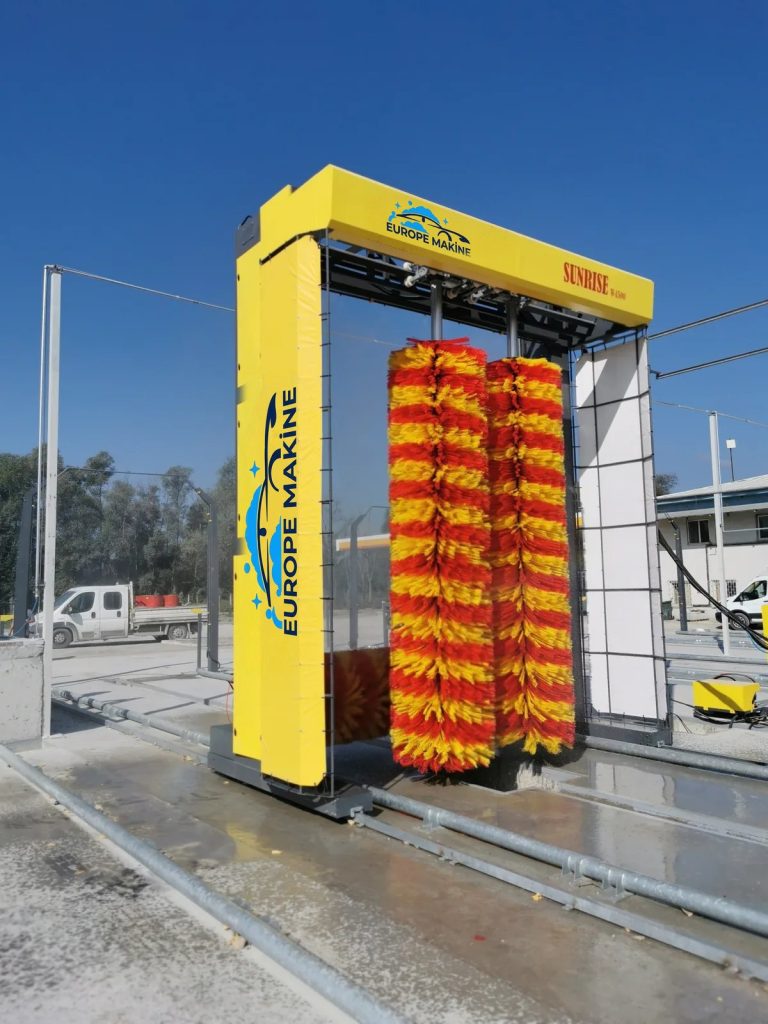
Europe Makine manufactures wash systems, including the SUNRISE W4000/W4700 heavy vehicle wash, and builds turnkey car washes. We have not established that any particular model is sized or approved for buses, so suitability, dimensions and throughput for your fleet would need to be confirmed with the manufacturer against your own specifications. Where a turnkey build is relevant, the work includes securing the site, clearing permits, installing and calibrating the equipment, training the crew and handing over a running operation. The permit step is the part that connects to the stormwater and discharge questions above.