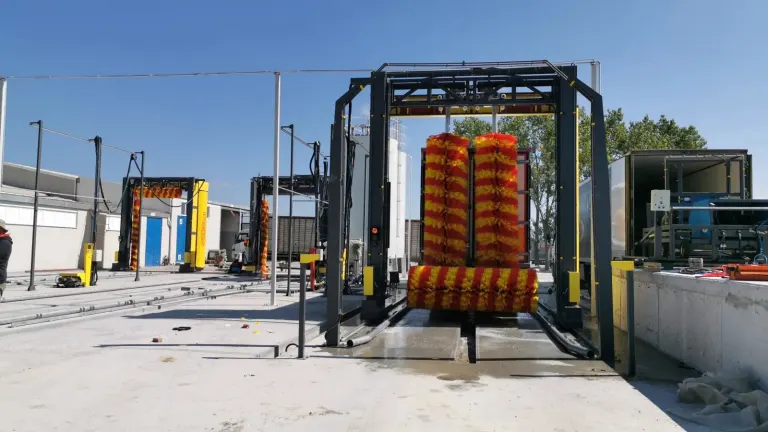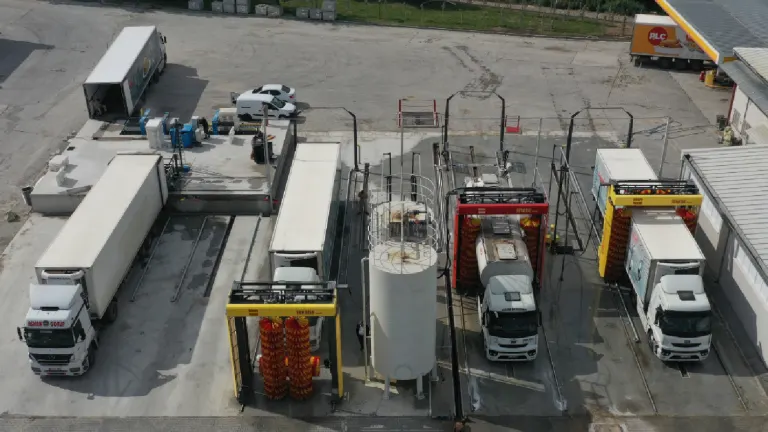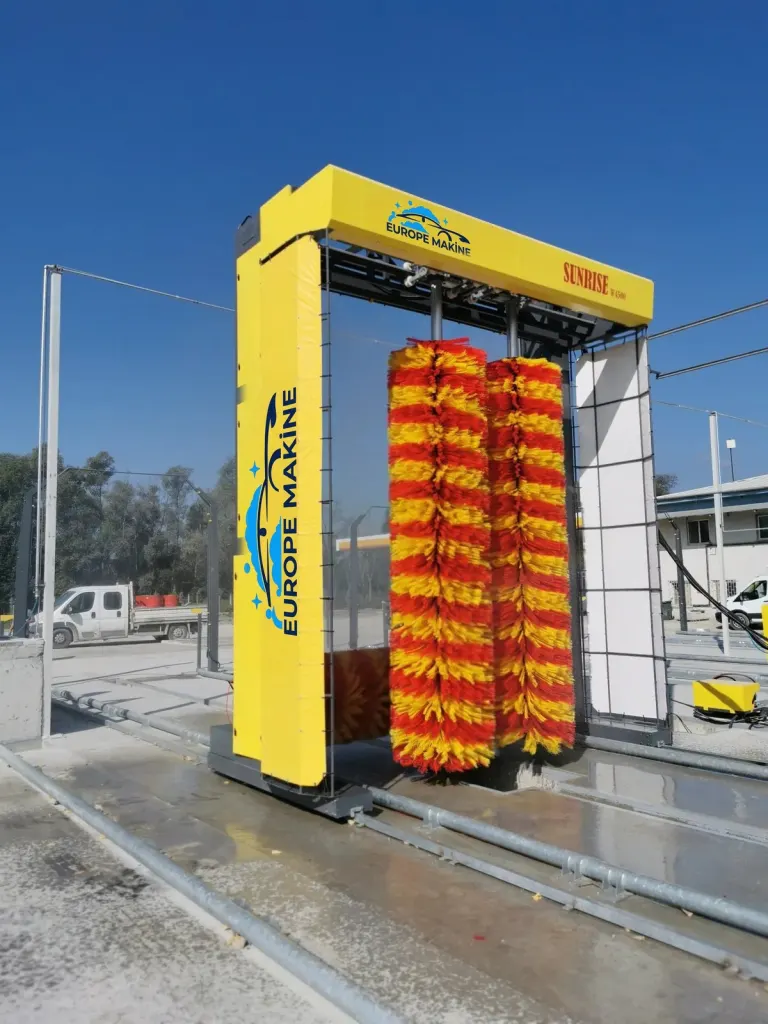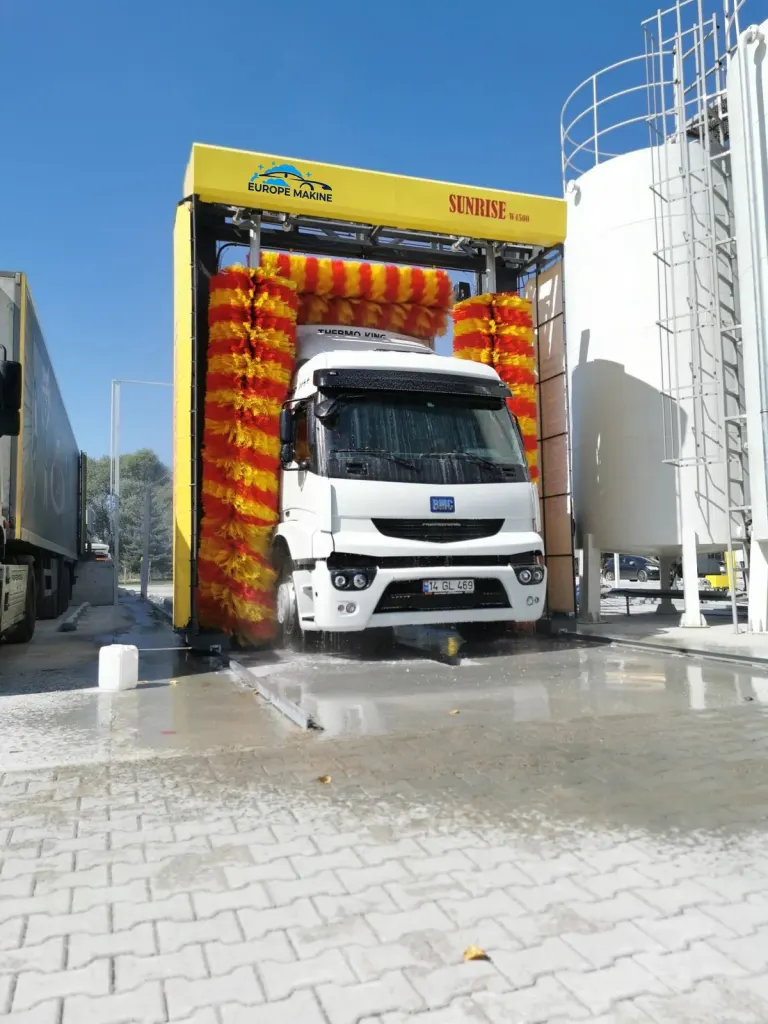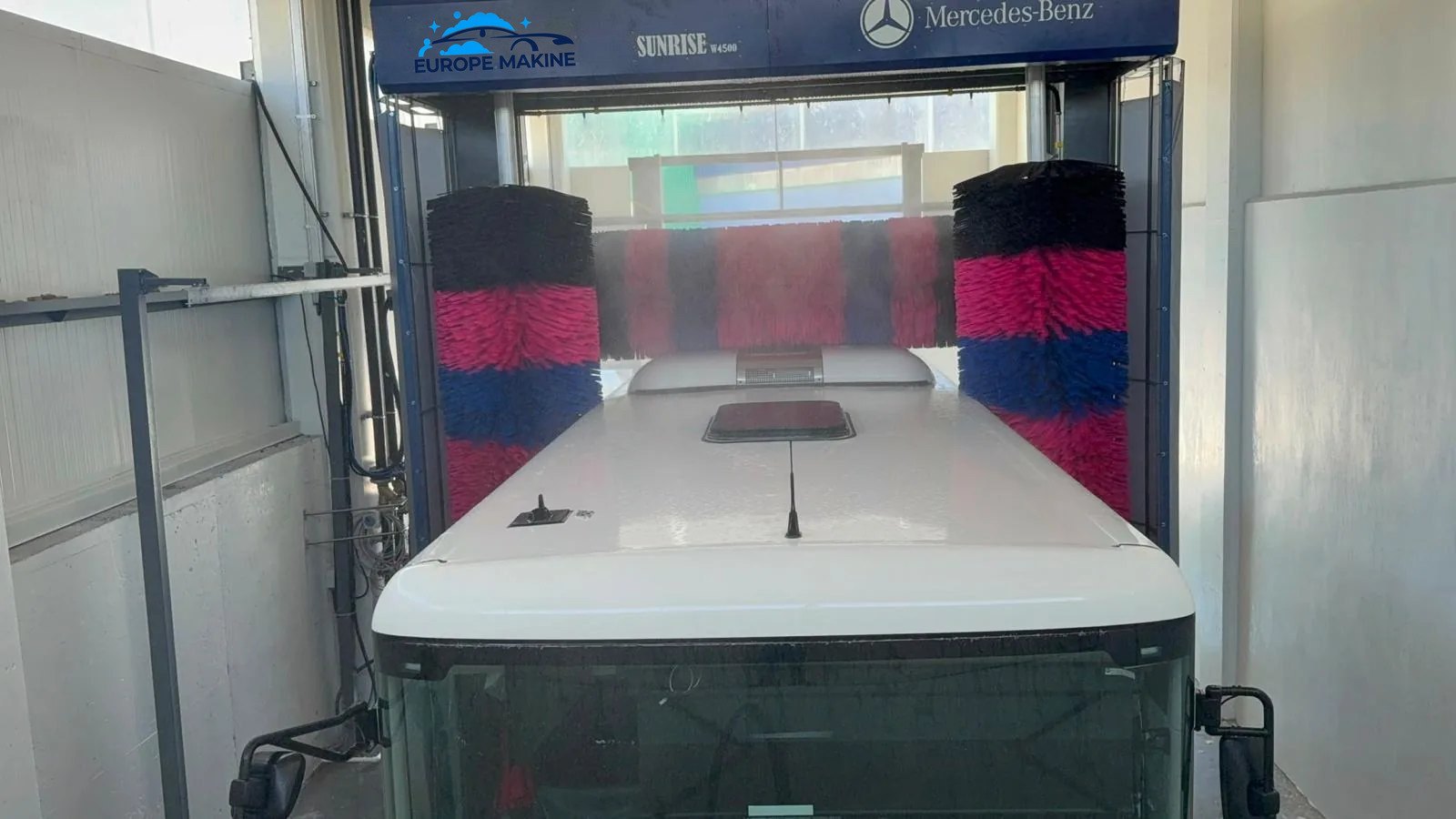
A lorry wash, in the sense most fleet and truck-stop operators mean, is a purpose-built bay where a heavy-duty truck or tractor-trailer is cleaned by machine instead of by hand with a pressure lance. Europe Makine’s version is the SUNRISE W4000/W4700 heavy vehicle wash, which washes about 6 vehicles an hour according to client figures dated 16 November 2026. What decides whether a bay like that works for you is rarely the washing itself. It is the vehicle envelope you specify, the wash water plan, and what your sewer authority says about both.
This article explains what a heavy-vehicle automatic bay is, which questions to settle about tractor units and trailers, how to read a throughput figure, and why wastewater and safety need planning before a machine is ordered. It is also plain about its limits. The public sources reviewed for this piece cover wastewater, environmental and safety context. They do not publish bay dimensions, vehicle height or trailer length limits, or wash-cycle details for truck washes. Where the answer depends on a specific machine, we say so rather than guess.
What a heavy-vehicle wash is, and what it is not
“Lorry” and “HGV” are mainly UK and EU terms. If you are searching for a lorry washing machine or an HGV wash in the US, the equivalent vocabulary is heavy-duty trucks, tractor-trailers and commercial vehicles. This article uses the US terms in the body and treats the others as the same subject.
Heavy-duty truck washing is a recognised vehicle-wash category. The EPA’s WaterSense at Work guide on vehicle washes says that similar washing equipment to a car wash is found at larger washing facilities that clean heavy duty trucks and buses. It also says such equipment is found at industrial facilities for wheel washing, to reduce dust entrainment as vehicles leave the site.
Those are two different jobs. A full-vehicle wash cleans the whole truck. A wheel wash at an industrial exit deals with what the tyres carry off the site. This article is about the first: an automatic bay that washes the vehicle itself.
In an automatic bay, the machine carries out the wash sequence. The crew’s job is to guide the vehicle in, supervise, and keep the bay running. The case for a machine over hand washing is consistency and crew time, but you should test that against your own vehicle numbers rather than take it on trust.
Tractor units, trailers and the combination: what to pin down in writing
The question in the title of this article, how an automatic bay handles tractor units and trailers, cannot be answered honestly from generic claims. The answer sits in the specification of the particular machine and bay. The approved material behind this article contains no verified maximum height, width or length for the SUNRISE W4000/W4700, so none is quoted here. Treat any supplier figure as something to obtain in writing and check against your own vehicles.
These are the points worth settling before you talk about price.
Whole combination or separate units?
Decide whether the bay is meant to wash a coupled tractor-trailer in one pass, or whether tractor and trailer will be washed separately. The answer affects bay length, the time each wash takes, the number of manoeuvres, and how many people are involved. Ask the supplier which pattern the quoted throughput assumes.
Height, width and length
Measure your own fleet. Do not rely on catalogue dimensions. Note the tallest vehicle including anything fixed to the roof, the widest including mirrors, and the longest combination you expect to run, including any extended trailers. Then ask for the machine’s limits on each dimension in writing, and for the clearances that apply to the building or canopy around it.
Trailer variety
Box trailers, curtain-siders, tankers, flatbeds and refrigerated units present different surfaces and fittings. Ask what the machine covers on each type, and what is left for hand finishing, such as the underside or fittings the machine does not reach. Ask the same of buses or other heavy vehicles if they will use the bay.
Approach, floor and turning space
A tractor-trailer needs room to enter and leave in a straight line, or to turn if the bay is not drive-through. Ask for the slab specification, the slope towards drainage, and the space the machine needs on either side. Check these against your site plan before you assume the bay will fit.
A useful discipline is a one-page vehicle schedule: each vehicle type, its measured dimensions, how often it is washed, and who is in the cab during the wash. Give it to every supplier you speak to. Answers will then be about your fleet, not an average one.
How to read a throughput figure of about 6 vehicles an hour
Europe Makine’s client figures put the SUNRISE W4000/W4700 at about 6 vehicles an hour. As a plain average, that is one vehicle every ten minutes. It is not a figure to compare with car-wash timings as though the two were like for like, because a heavy vehicle is a different washing task.
Before you build a business case on it, ask what the figure counts.
- Does a vehicle mean a tractor-trailer combination, or each unit separately?
- Does the time include driving in, positioning and driving out, or only the wash itself?
- What kind of vehicle and what level of soiling was it based on?
Then consider the shape of your demand. A depot where vehicles return in a short window will meet its queue at the peak, not at the average. Plan the waiting area so that trucks do not block the yard or the public road while they wait. If most of your washing is scheduled, you may be able to spread arrivals and keep the bay steadily busy. If it is walk-in demand from passing drivers, the peaks are harder to predict.
This article offers no per-truck water use, chemical programme or payback figure, because no verified numbers were available. Be wary of any that arrive without the working behind them.
Wash water is the real planning job
The bay is the visible part. The drainage and treatment behind it decide whether you can operate at all.
What is in heavy-vehicle wash water
The EPA’s stormwater best management practice sheet, Municipal Vehicle and Equipment Washing, says wash water can contain sediment, detergents, oils, grease and heavy metals. It adds that both commercial and residential wash water can carry contaminants from vehicle fluid leaks, wear and the cleaning process itself.
That sheet is written for municipal fleets such as public works trucks, fire trucks and school buses. A commercial truck wash is a different setting, but it is sensible to plan on the same basis: what comes off a heavy vehicle is not clean water.
Contain, treat or reuse
The same EPA sheet says wash water should be contained, treated or reused. It says treatment systems generally include oil/water separators or filtration, and that regulations often require treatment where a facility discharges wash water to the sanitary sewer.
It also sets out the order of events for a sewer connection. The operator would seek the sewer authority’s permission first, because wash water may have special treatment requirements. It adds that a wash area can be designed to recycle wash water. In practice, this means your drainage plan comes before your machine order, not after it.
Where the water goes
The EPA’s Industrial Stormwater Fact Sheet for transportation facilities (Sector P) gives the same direction for vehicle wash or rinse water. It recommends the sanitary sewer “if allowed by sewer authority”, and lists wastewater treatment, a land application site, or recycling on site as the other options. It recommends containing and recycling washwaters, and training employees in proper washing procedures. The retrieved text carries no effective date and the file path suggests 2015, so read it as general practice rather than current rule.
The International Carwash Association’s study, Water Effluent and Solid Waste Characteristics in the Professional Car Wash Industry, states that 99% of professional car washes discharge to publicly owned treatment works. It contrasts that with street washing, where soaps, oil and grime go into the stormwater system, which does not treat water before discharge. Two cautions apply. The figure is the ICA’s own, and the retrieved text is undated. The study also covered in-bay automatic, self-service and conveyor car washes, not truck washes, so it is not a truck-wash statistic. It does show the principle: a contained bay draining to treatment is the accepted route, and washing on the yard or street is the problem it replaces.
Water reclaim
The EPA’s WaterSense at Work section on vehicle washing says an in-bay wash can benefit from a water reclamation system. It points out that because there is typically only one wastewater collection pit, an in-bay reclamation system must be properly designed to separate contaminants.
For a heavy-vehicle bay that is the central design question. Section 5.4 of the same guide lists what to assess when designing reclamation: the nature and concentration of contaminants, daily water volume, flow rates, and the chemicals and procedures used. Ask any supplier proposing a reclaim system to work through that list for your fleet, with your soiling and your volumes.
Servicing the separator
An oil/water separator is not fit-and-forget. The EPA’s environmental screening checklist for the trucking industry says oil/water separators are typically connected to floor drains or wash racks, and that they require periodic servicing to maintain performance. That document dates from August 2000 and is archived, so use it only for the general maintenance point. Put separator servicing in your running costs and your maintenance calendar from the start.
Who sets the rules
The EPA material reviewed for this article is guidance and best-management-practice fact sheets, not a rule that tells you what to do on your site. Wastewater requirements are set locally by the sewer authority and by state and local permits. We cite no limits or rule numbers here, because they differ by location and change. Your first call is to the sewer authority and your local permitting office, before you commit to a site layout.
Safety questions to ask before the bay is built
A wash bay combines wet floors, chemicals, moving vehicles, pumps and powered equipment. The hazards are recognised in the car wash industry, even though the sources here are not specific to truck washes.
OSHA’s alliance with the International Carwash Association, signed on 1 November 2005 and concluded on 1 November 2007, focused on slips, trips and falls, hazard communication and vehicle operation safety. It produced a Safety Tips Sheet on slips, trips and falls. It is dated and closed, so treat it as background on what the industry already knew to be a problem.
More recently, on 23 September 2026, OSHA announced that the Department of Labor had cited a New Jersey car wash operator for willfully exposing workers to hazards from hazardous energy and excessive noise, and proposed penalties. A proposed penalty is not a final finding, and we draw no conclusion about the operator. We mention it only because it points to two questions worth putting to any equipment supplier.
- Maintenance isolation. How is the machine made safe for servicing, how are the energy sources locked off, and who on your crew is trained to do it?
- Noise. What noise do the pumps and other equipment produce in the bay and the equipment room, and what does the supplier recommend for the people working nearby?
Add the practical points. How is the floor finished and drained to reduce slip risk? Where should the driver be during the wash: in the cab, or clear of the bay? How are chemicals labelled and stored? A supplier who has thought about these will usually have specific answers. Your own safety adviser and local requirements should have the final say.
Running the bay day to day
A bay that stays open is a bay someone maintains. Before you buy, find out who services the machine, where spare parts are held, and how long a repair normally takes. The Sector P fact sheet recommends training employees in proper washing procedures, which is a good principle for the crew too: write down the routine for starting, supervising and shutting down the bay, and the routine for what to do when something goes wrong.
Plan the wastewater routine as a regular task, not an occasional one: separator servicing, pit cleaning, and checks that the drainage is doing what the permit says. If your site has a reclaim system, include its checks in the same schedule.
Where Europe Makine fits
Europe Makine is a car wash equipment manufacturer with more than 30 years of manufacturing experience and a 1,500 square metre production facility. It builds five systems: the Acrobat 2X touchless rollover, the Ephesus three-brush rollover, the Cirrus 5N five-brush rollover, a conveyor tunnel system, and the SUNRISE W4000/W4700 heavy vehicle wash discussed here. It exports to Israel, Germany, Poland, Italy, Romania, Azerbaijan, the UAE and other markets.
For US customers, the company also offers a turnkey service. It secures the site, clears permits, installs and calibrates the machines, hires and trains the crew, and hands over a running operation. That is relevant to the wastewater and sewer-authority points above, because permits and drainage are part of the build rather than an afterthought. The US base is in Greenacres, Florida, with service technicians and a spare parts stock. Machines ship with door-to-door delivery, free installation and a 12-month warranty.
A short checklist before you talk to any supplier
- Write a vehicle schedule with measured height, width and length for each vehicle type, and decide whether you will wash combinations or separate units.
- Get the machine’s vehicle limits and bay and slab requirements in writing.
- Ask what the throughput figure counts, and compare it with your own peak arrivals.
- Speak to your sewer authority before fixing the drainage layout, and ask what treatment it expects.
- Have the supplier work through the contaminant, volume, flow and chemical assessment for any reclaim system.
- Put separator servicing and pit cleaning in your maintenance plan.
- Ask how the machine is isolated for maintenance, what noise it produces, and how the floor deals with wet conditions.
None of this replaces advice for your own site. It should help you ask better questions of the people who will design, permit and build it.