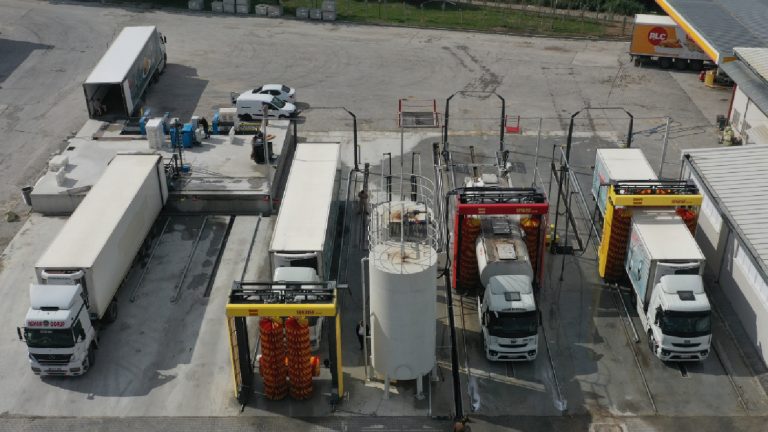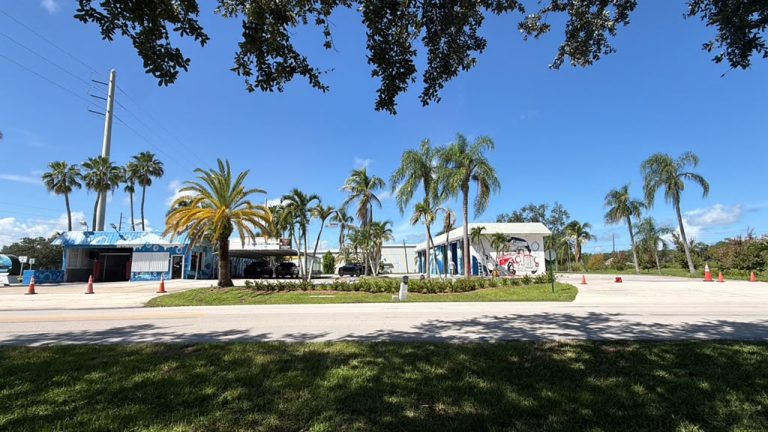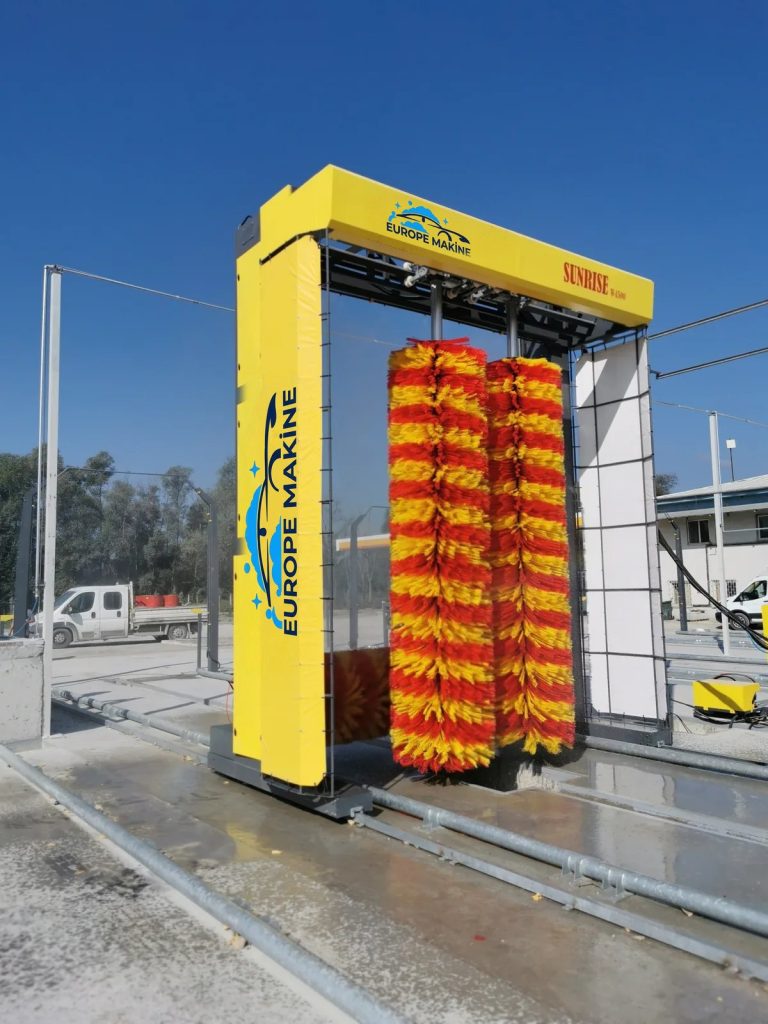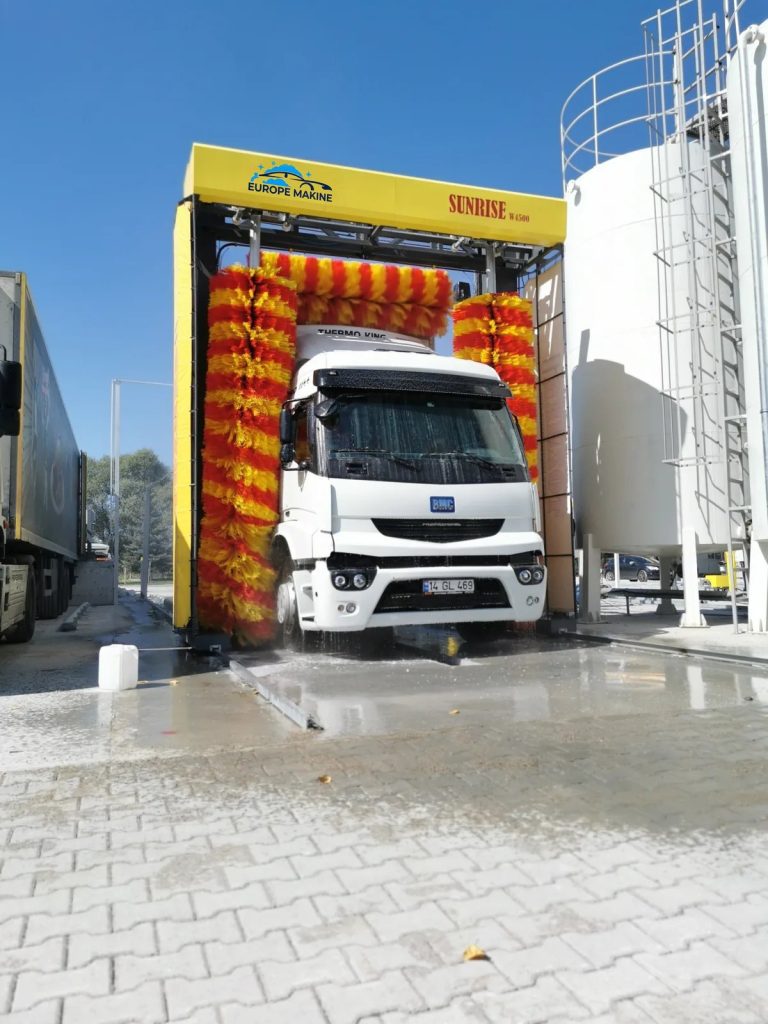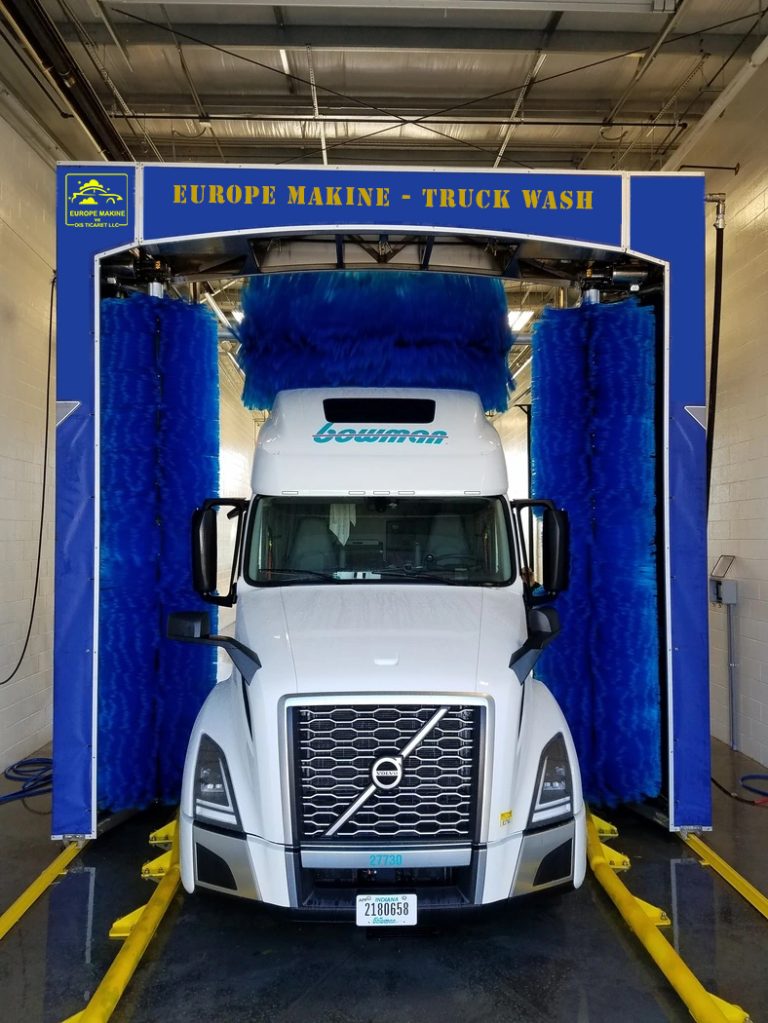
If you are planning a large vehicle car wash, start by separating two questions: what the vehicle measures on the road, and what the wash equipment can physically accept. Tunnels and rollover machines are built around cars, pickups and vans. Heavy-duty trucks and buses are normally washed at larger facilities with equipment built for them, and that is where a dedicated truck bay comes in. The deciding information is the manufacturer’s spec sheet and a measured envelope of the vehicles you want to wash, not a general rule of thumb.
This article explains how to make that comparison, which formats exist, what the public sources say about heavy-vehicle washing, and what to settle before you commit to a layout. It does not give tunnel dimension limits, because no reliable published figure applies to every machine. The limit belongs to the specific equipment you are considering.
Legal road size is not the same as wash-bay size
It is tempting to use road regulations as a shortcut. If a truck is legal on the highway, surely it fits a wash? It does not follow. Road rules describe what a vehicle may be on a public road. A wash tunnel has its own opening, its own conveyor, and its own envelope of brushes, arches, sprayers and dryers. Those are set by the equipment, not by traffic law.
The road rules are still a useful reference point, because they tell you how much variation to expect. The Federal Highway Administration (FHWA), part of the US Department of Transportation, explains in its guide to federal size regulations for commercial motor vehicles that there is no federal vehicle height requirement for commercial motor vehicles, so States may set their own height restrictions. It adds that most height limits range from 13 feet 6 inches to 14 feet.
On width, the FHWA’s Commercial Vehicle Size and Weight Program page gives the standard commercial truck width as 102 inches, and says that on the National Network no state may impose a width limit of more or less than 102 inches.
Two practical points follow from this:
- Height is not uniform. Because States set their own height limits, a vehicle that is legal in one state may be taller than the typical limit in another. A fleet that crosses state lines cannot assume one height for planning.
- Legal does not mean washable. A vehicle at the legal limit on the road is a vehicle at the edge of what many wash openings were designed around, and possibly beyond it. The road figure tells you the vehicle is lawful. It tells you nothing about clearance inside a particular machine.
Treat the road regulations as background, then move to the document that matters: the equipment specification.
Why standard wash equipment is built around ordinary vehicles
The International Carwash Association (ICA) publishes a short reference called Vehicle Size Extremes. It frames the problem well: a car wash has to cope with thousands of different vehicle types, from small cars through to pickups and vans. The material we could retrieve gives no measurements, so we will not quote any, but the framing is the useful part. A tunnel is designed around a practical range of vehicles. The further a vehicle sits from the middle of that range, the more the operator has to check before it goes in.
That is why the question of oversized vehicles is a design question first and an operating question second. A machine that handles saloons, SUVs and pickups every day is doing what it was built to do. Asking it to take a tall box van, a lifted truck with accessories, or a vehicle with equipment mounted on the roof is asking for something outside that design, and the result may be damage to the vehicle, to the machine, or to both.
The formats: conveyor, in-bay automatic and self-service
The US Environmental Protection Agency’s WaterSense programme describes how vehicle washes are classed in its WaterSense at Work guidance on vehicle washes. The classification is by equipment type, which is a helpful way to think about fit.
Conveyor systems
In a conveyor system, sprays or brushes are mounted on stationary arches, and the vehicle is moved along a conveyor underneath them. The vehicle is carried through a fixed sequence. That makes the equipment envelope fixed too: whatever the arches, brushes and dryers are set up to clear is what the vehicle must fit within, along its whole length.
In-bay automatic systems
In an in-bay automatic system, the vehicle stays still and the sprays or brushes move around it on a gantry. Operators often call these rollover machines. The vehicle is not carried by a conveyor, so conveyor constraints do not apply, but the gantry still has a defined travel path and a defined clearance.
Self-service bays
Self-service bays leave the washing to the driver with a wand or similar equipment. They are the most forgiving about vehicle shape, because a person is directing the water, though the bay itself still has a finite size.
Where heavy-duty trucks and buses sit
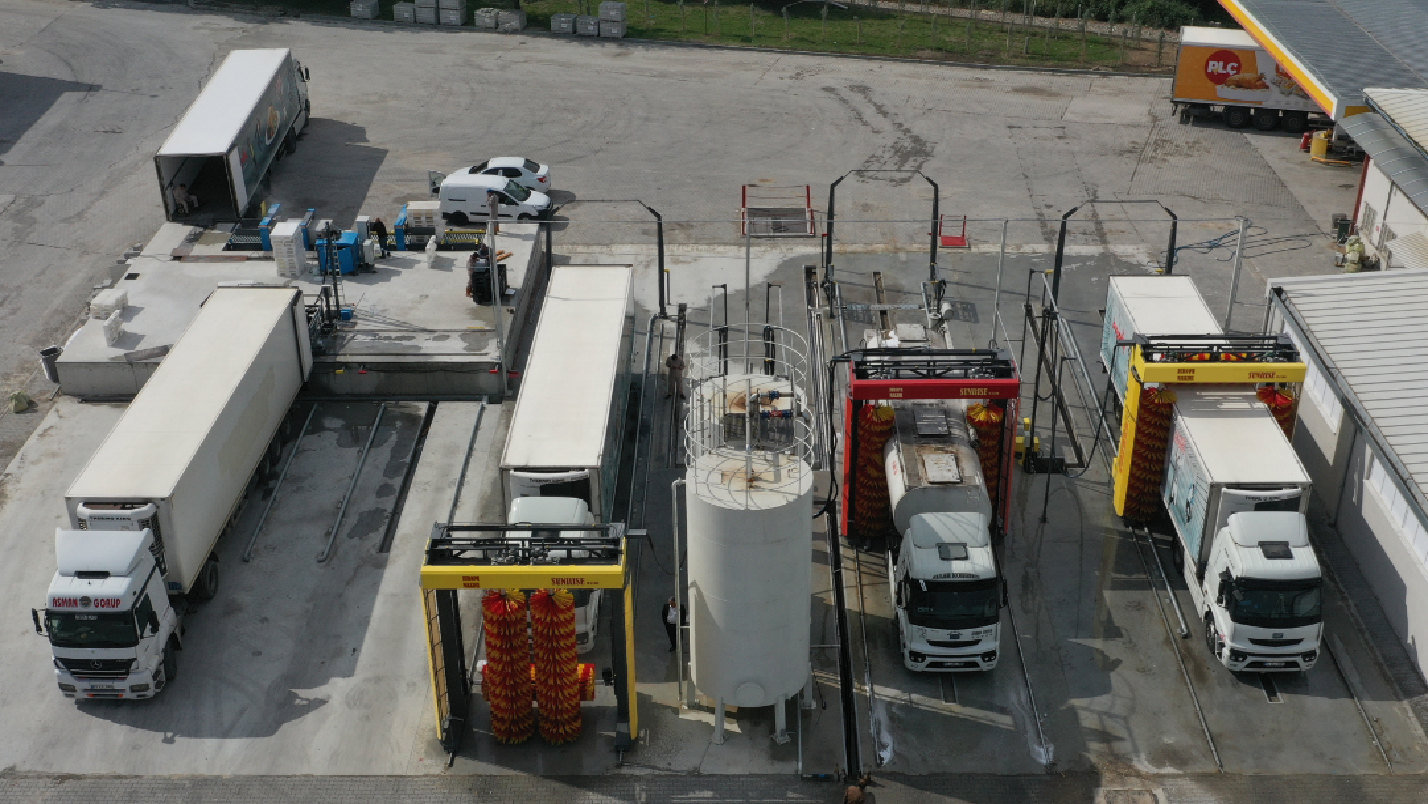
The same EPA guidance notes that similar equipment is found at larger washing facilities that clean heavy-duty trucks and buses. In other words, heavy-duty vehicles are not simply treated as very big cars. They are served by a separate and larger class of facility, with equipment of the same general type but built to a different scale.
The business category exists in formal classification too. The OSHA Standard Industrial Classification entry for code 7542, Carwashes, covers establishments that wash, wax and polish motor vehicles, and the listed activities include both bus washing and truck washing. Truck and bus washing is a recognised part of the car wash trade, not a curiosity.
What a tunnel or rollover does well
For standard vehicles, tunnels and rollovers are a good fit, and it is worth being clear about what they do well before deciding that you need something else.
Europe Makine’s own throughput figures give a sense of the range for standard vehicles. These are manufacturer figures for cars and similar vehicles, and they do not apply to heavy vehicles:
- The Acrobat 2X, a touchless rollover, washes 3 to 5 vehicles per minute of operation time.
- The Cirrus 5N, a five-brush rollover, averages 24 to 32 vehicles per hour wash-only, or about 14 with drying.
- The conveyor tunnel washes and dries 30 to 60 vehicles per hour.
The point of listing them is the contrast. A tunnel earns its place by moving a steady stream of similar vehicles quickly. That is a different job from washing a single large truck thoroughly, which is usually slower, more hands-on, and less predictable in shape. If the bulk of your traffic is standard vehicles, a tunnel or rollover that is not asked to handle the exceptions will serve you best.
Measure the vehicle before you ask the question
Most disagreements about whether something fits come down to a vehicle that was never properly measured. A driver says it is a standard pickup. The vehicle has a roof rack, a light bar, a raised suspension and wide mirrors. None of that is in the registration document.
Before you decide on a format, collect these measurements for each vehicle type you want to wash, using the vehicle as it actually operates:
- Overall height, including roof racks, beacons, aerials, ladders, air-conditioning units and anything else mounted on top.
- Overall width, including mirrors and any side-mounted equipment, not just the body.
- Overall length, including bumpers, towbars, ladders, bodywork overhangs and any rear equipment.
- Wheel and tyre details, particularly for conveyor systems, where the vehicle is carried along a track. Note any dual rear wheels or unusually wide tyres.
- Ride height where the suspension has been raised or lowered.
- Fixed accessories such as bull bars, snow ploughs, side steps, tool boxes and external pipework, which can catch on brushes or arms.
Then ask the equipment supplier for the matching specification: the maximum vehicle dimensions the machine is rated to accept, and any other limits they state. Compare the two lists line by line. If any single measurement is outside the stated limit, that vehicle does not go through that machine, however close it looks.
Allow for the vehicles you cannot predict
Fleet vehicles are at least known. A public wash is not. If you open a tunnel to the public, a driver will sooner or later arrive in something unexpected. The answer is a clear entry rule at the door, based on the spec sheet, so that staff do not have to judge it by eye with a queue behind. A height bar or clear signage at the entrance is a cheap way to prevent an expensive mistake. Where that sort of vehicle is a regular part of your trade, that is the sign you need a different format, not a firmer sign.
When a truck bay is the answer
A dedicated truck bay, sometimes called a heavy vehicle wash, is the right answer when one or more of the following is true.
Your vehicles are outside the tunnel’s envelope
This is the plainest case. If trucks, buses or tall commercial vehicles do not fit the stated limits of a conveyor tunnel or rollover, no amount of care at the entrance will change that. The EPA’s description of larger facilities that clean heavy-duty trucks and buses points the same way: these vehicles are served by facilities designed for them.
You wash the same large vehicles repeatedly
A fleet of buses, delivery trucks or work vehicles is a known, repeating load. You can measure the vehicles once, design the bay around them, and schedule washing around the operation. That predictability is something a public tunnel rarely has, and it is one of the strengths of a bay built for the job.
You want to keep heavy vehicles out of the car queue
Even when a large vehicle would technically fit, it may not belong in the same lane as cars. A heavy vehicle that takes longer to wash can hold up a queue of standard vehicles that would otherwise be moving steadily. Separating the two flows keeps the car side predictable and gives the larger vehicles the time they need.
The vehicles are dirtier or more varied than a tunnel expects
Heavy vehicles often come in with more road film, mud or load residue than a typical car. That is a general observation, not a measured one, and the right method for any given vehicle should be confirmed with the equipment supplier. The point is that the wash method, chemistry and cycle for heavy vehicles may differ from a car cycle, and a bay designed for them can be set up accordingly.
When a truck bay is probably not the answer
If you rarely see anything outside the standard range, a truck bay is more equipment than you need. Occasional large vehicles may be better handled by declining them politely, or by pointing the driver to a facility that specialises in them. Building a bay for a trickle of demand is a poor use of space and capital, and we have no verified figures on truck-wash demand to suggest otherwise.
Wash-water capture matters more with big vehicles
Large vehicles bring more surface, more dirt and more water, and the water has to go somewhere. The EPA’s fact sheet on vehicle maintenance and washing notes that outdoor car washing can send detergent-rich water into storm drains, and that this water may carry high amounts of nutrients, metals and hydrocarbons.
For a heavy-vehicle bay, that is a reason to design drainage and capture from the start. A bay that is contained, drained and plumbed properly is a better neighbour and a more defensible site. A bay that sends runoff toward a street drain is a problem waiting to be noticed.
We have not verified any specific federal rule on truck-wash discharge, so we will not state one. Wastewater and permit requirements are set at site level, and they differ between places. Confirm what applies to your site with your local and state authorities before you finalise a design. Do it early, because drainage choices are expensive to change once the concrete is poured.
Planning a site that handles both
Many operators will not choose between a tunnel and a truck bay. They want both: a tunnel for the steady stream of cars, and a bay for the larger vehicles. If that is your plan, a few layout points are worth settling early.
- Separate entrances. Drivers of large vehicles need to see where to go before they commit to a lane. Clear signs and separate approaches stop a tall vehicle from joining the tunnel queue by mistake.
- Turning space. Large vehicles need room to approach, position and leave. Check the swing of the longest vehicle you expect, not the average.
- Queueing. Decide where a waiting truck stands so that it does not block the car lane or the public road.
- Drainage. Keep the heavy-vehicle area’s wash water on its own capture route as far as the site allows, so you can treat and manage it separately.
- Staffing. A tunnel can run with a small crew. A truck bay often needs somebody who can guide a large vehicle in safely. Plan for that person.
None of this requires exotic equipment. It requires thinking about the largest vehicle on its worst day, rather than the typical vehicle on a quiet one.
Questions to put to any equipment supplier
Whatever format you choose, a good supplier should be able to answer these plainly and in writing:
- What are the maximum height, width and length the machine is rated to accept, and how are they measured?
- What happens to vehicles with roof equipment, wide mirrors, dual rear wheels or raised suspension?
- What other limits apply, such as tyre width, wheel type or weight?
- How does the machine handle a vehicle that has stopped or is mis-positioned?
- What drainage, water supply and power does the equipment need?
- What does the site need for wash-water capture, and what do local authorities usually ask for?
- What is the realistic throughput for the vehicle type I actually want to wash, rather than a figure for cars?
That last question is worth pressing. Throughput figures quoted for cars say nothing about a truck, and a supplier that cannot give you a figure for your vehicle type should say so rather than extrapolate.
Where Europe Makine fits
Europe Makine manufactures five wash systems: the Acrobat 2X touchless rollover, the Ephesus three-brush rollover, the Cirrus 5N five-brush rollover, a conveyor tunnel system, and the SUNRISE W4000/W4700 heavy vehicle wash. The first four cover standard vehicles. The SUNRISE is the heavy-vehicle option, which is the truck-bay answer discussed above. We have not set out its dimensions or throughput here, so confirm the specification for your vehicles directly against the manufacturer’s spec sheet before you plan around it.
The company also builds turnkey car washes. In that process it secures the site, clears permits, installs and calibrates the machines, hires and trains the crew, and hands over a running operation. For a site that needs both a tunnel and a heavy-vehicle bay, having drainage, permits and layout handled as one project can save you from discovering a conflict between them late on.
A short checklist before you decide
- Measure your real vehicles, including everything attached to them.
- Get the machine’s stated limits in writing and compare them one by one.
- Do not use road-legal dimensions as a stand-in for wash-bay fit.
- Decide whether heavy vehicles are a regular part of your trade or an occasional exception.
- If regular, plan a separate bay and a separate flow from the car queue.
- Design wash-water capture from the start and confirm local and state requirements early.
A wash that stays open is one where nobody is surprised by a vehicle at the entrance. Measuring first, choosing the format to suit, and keeping large and standard vehicles in their own lanes does most of the work.